Testing · Updated 18 August 2026
Taylor kits, decoded
K-1000, K-1001, K-1004, K-1005, K-2005, K-1766. It looks like a ladder. It isn’t — two of them read exactly the same nine things.
Which Taylor kit do you need?
Tick what you want to measure. We'll name one kit, not six.
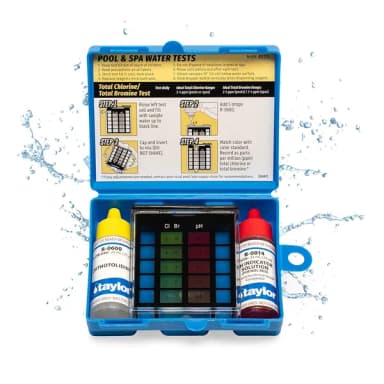
The classic yellow-and-red OTO kit. Reads total chlorine only — it cannot separate free from combined, so it will not show you chloramines.
Check our work
Every Taylor kit, and what it reads
Reading lists from Taylor’s own product descriptions. Swipe sideways on a phone.
| Kit | Chlorine | Free vs total chlorine | pH | Total alkalinity | Calcium hardness | Cyanuric acid | Salt | Price |
|---|---|---|---|---|---|---|---|---|
| K-1000 | Yes | — | Yes | — | — | — | — | $14.90 |
| K-1001 | Yes | — | Yes | — | — | — | — | $16.99 |
| K-1004 | Yes | Yes | Yes | Yes | — | — | — | $27.99 |
| K-1005 | Yes | Yes | Yes | Yes | Yes | Yes | — | $50.20 |
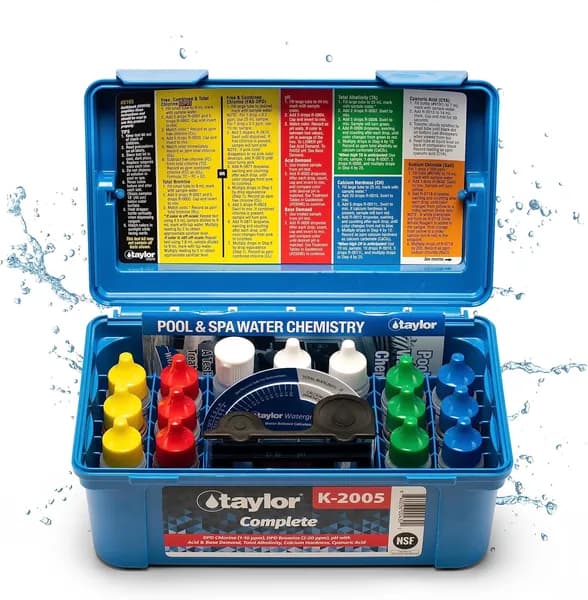
| K-2005 | Yes | Yes | Yes | Yes | Yes | Yes | — | $68.99 |
| K-1766 | — | — | — | — | — | — | Yes | $35.99 |
The trap in the middle of the range
The K-1005 and K-2005 read the same nine things
This is the single most useful thing to know about the range, and it is not obvious from the K-numbers. Both kits measure free and total chlorine, bromine, pH, acid and base demand, total alkalinity, calcium hardness and cyanuric acid. The difference is reagent bottle size, not capability.
The K-1005 costs a little less and runs out sooner. Buyers rate it lower — 4.3 against 4.6 — on roughly a fifth of the review volume. If you are choosing between them, the K-2005 is the one to buy, and the saving on the K-1005 disappears the first time you replace reagents.
The genuinely different kits are at the ends: the K-1000 is an OTO kit reading total chlorine only, so it cannot show you chloramines at all, and the K-1766 reads salt and nothing else.
Not sure Taylor is the right call at all? Strips versus drops, decided in four taps.
Why the range exists at all
Taylor sells a testing system, not six products
The reason the K-numbers look arbitrary is that they are not really products — they are bundles of the same reagents in different combinations. Every kit is built from the same catalogue of numbered bottles, which is why the range appears to jump around: the K-1004 and K-2005 share most of their contents, and the K-1005 sharesall of the K-2005’s in smaller quantities.
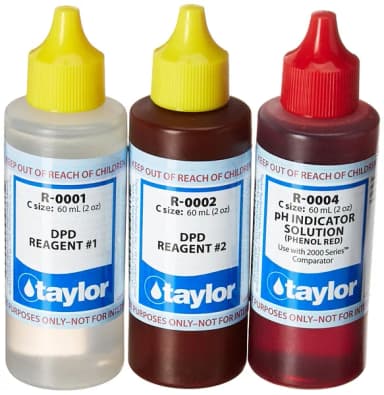
Once you see it that way the buying decision changes. You are not choosing a capability tier, you are choosing which bottles you want to own and how much of each. It also explains the range’s real running cost: when a kit “dies”, one bottle has usually expired or run out, and buyers repeatedly report that bottle being R-0002, the DPD chlorine reagent. Replacing it costs a fraction of a new kit — several reviewers asked for exactly that without realising Taylor already sells it.
The corollary matters for anyone buying secondhand or from an unfamiliar seller: check the bottles against the instruction sheet on arrival. Kits do turn up with a bottle doubled and another missing, and because they contain chemicals they are frequently return-ineligible.
Worked example
What a Taylor kit actually costs over three seasons
A 20,000 gallon chlorine pool, tested twice a week across a 20-week season, using the K-2005 and replacing reagents as they run out.
- 1K-2005 kit, bought once$68.99
- 2Basic reagent refill, season twoReplaces the solutions that expire first$24.02
- 3R-0870 DPD powder, season threeThe single reagent buyers run out of first$10.49
- 4Three-season total$103.50
- 5Tests performedTwice weekly × 20 weeks × 3 seasons120
- 6Cost per test$0.86
Under a dollar a test, and that is the expensive kit. The comparison people actually make is against free testing at the pool store — which is genuinely free, and is also a sales appointment, hours old by the time you act on it, and a car journey away when your chlorine drops on a Saturday.
Use both. The store test is a useful second opinion on calcium and CYA a couple of times a season, because those drift slowly and a cross-check is worth having. Everything that moves daily, you need to be able to read at the pool.
Whichever you buy
Budget for reagents before you need them
The loudest complaint across every Taylor kit we read was reagents arriving close to expiry — most often the DPD reagent, while the rest of the kit was good for a year or more. Buyers also report kits being return-ineligible because they contain chemicals, so a bad batch is money gone.
Check the dates the day it arrives, and keep a refill on hand. Rebuying a complete kit because one bottle died is the most common avoidable expense in pool testing — and several buyers asked for refills in reviews without realising they already exist.
Using it
The technique matters more than the kit
A drop kit is only as good as the person holding it, and the mistakes that produce bad readings are consistent enough to list. None of them are difficult to avoid once somebody tells you.
Rinse the comparator between tests. Residue from a previous reagent is the most common source of a reading that makes no sense. Rinse with pool water, not tap water — tap water has its own chlorine and its own pH and will quietly skew everything.
Collect the sample properly. Elbow-deep, away from the returns and away from the skimmer, with the pump running. Water taken from the surface next to a return jet is not representative of the pool, and a sample from a dead corner isn’t either.
Hold the bottle vertical and count slowly. Reagent bottles are calibrated to deliver a specific drop size when held straight down. Tilted, you get smaller drops and an artificially high count, which on a titration test translates directly into a wrong number.
Read in indirect daylight against white. Not under a kitchen bulb, not in direct sun, not against the sky. This is the single change that resolves most “the colours all look the same” complaints, and it costs nothing.
Making it last
Reagents are the running cost, and heat is what kills them
The kit itself is a plastic case and a comparator block; neither wears out. What you are actually buying over time is reagent, and reagent has a shelf life that most people shorten without realising.
Store the case indoors, cool and dark — not in the pool shed, not in the garage, and never in a car. Heat degrades the DPD reagents fastest, which is consistent with buyers reporting R-0002 as the bottle that fails first far more often than the others. A kit that lives beside the pool in August is being cooked between tests.
Cap bottles immediately and don’t swap caps between them — cross-contaminating two reagents ruins both. Write the date you opened it on the label, because the clock that matters starts at opening rather than at purchase, and a bottle that has been open two seasons should be replaced whether or not it looks fine.
When something does expire, replace that bottle. The whole point of a catalogue-numbered reagent system is that you never have to rebuy a kit, and buyers routinely do it anyway because nobody told them the individual bottles exist.
The other serious brand
Taylor or LaMotte?
Taylor is not the only drop-kit maker worth taking seriously. LaMotte is the other name that comes up among people who test carefully, and the honest summary is that both are good and they suit different temperaments.
Taylor is the more open system: reagents are individually numbered, individually available, and widely stocked, which makes long-term running costs low and replacement easy. That openness is the main practical reason it dominates enthusiast recommendations.
LaMotte tends toward more self-contained kits and, at the higher end, digital colorimeters that remove the colour-matching judgement entirely. If reading colours is the part you find hard — and reviewers of every drop kit say some version of this — that is a real advantage rather than a gimmick.
We have not compared them side by side and we are not going to claim we have. What we can tell you is what the systems are and where the running costs sit. For genuine multi-season comparisons between the two brands’ reagents, TroubleFreePool’s forum has years of it, written by people with nothing to sell.
Where this leaves you
If you're going to own one Taylor kit, own this one
- Reads the same nine things as the K-1005 with larger reagent bottles
- 4.6 stars across 3,624 reviews — the most buyer history in the range
- Works out at roughly $0.86 per test across three seasons
- Every reagent is sold individually, so one expired bottle is never a new kit
We have not tested this kit ourselves — see our editorial policy. Buyers are genuinely split on the learning curve, and we quote both sides in the FAQ below.
From the reviews we read
What Taylor owners actually ask
Grounded in 50 verified reviews of the K-2005 and K-1004, sorted by how many people found them helpful. Where buyers disagreed, we say so rather than picking a side.