Chemistry · Updated 18 August 2026
Pool shock calculator
Shocking is not one dose. Algae and chloramines need different levels, and your stabiliser decides both. Enter three readings and get the higher of the two.
How much shock does your pool need?
Two readings, not one. Algae and chloramines need different levels — this returns whichever is higher.
At CYA 40 the level that actually kills algae is 16 ppm, which is above the 10 ppm your combined chlorine alone would need. That is the number to hit. You are reading 1, so add 3 lb 11.2 oz of cal-hypo shock to 19,200 gallons — a rise of 15 ppm — after sundown with the pump running.
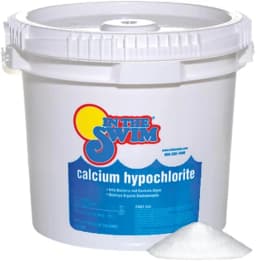
In The Swim Cal-Hypo Pool Shock, 25 lb
65% available chlorine — the figure this dose was calculated from, taken from the listing's description rather than the 68% on the front of the bag.
$109.99 · 4.6★ · 16,236 reviews
Why gallons is the wrong question
“One pound per 10,000 gallons” is right for one pool
Almost every shock calculator, and almost every bag of shock, works from a single input: how big is the pool. Multiply, weigh, pour. It is a clean answer to a question nobody asked, because volume tells you how to spread a dose, not how big the dose has to be.
Work the arithmetic on the bag instruction and you can see the assumption inside it. One pound of 65% cal-hypo in 10,000 gallons raises free chlorine by about 7.8 ppm. That is a real shock level — for a pool carrying almost no cyanuric acid. Put the same pound into a pool at CYA 60, where the level algae cannot survive is 24 ppm, and you have landed roughly two thirds short — you have spent the chemical, done the work, and not cleared the pool.
This is the same mechanism that makes routine dosing go wrong, and for the same reason: cyanuric acid binds chlorine and holds it in reserve, so the more of it you have, the more total chlorine you need for the same active effect. On a normal day that moves your target from 3 ppm to 11. On a shock day it moves it from 10 ppm to 32.
The two problems people call “shocking”
Chloramines and algae are not the same job
The word covers two different situations that happen to share a remedy, and the reason most people shock twice is that they solved for one and got the other.
Chloramines in clear water. Chlorine reacts with the nitrogen compounds swimmers bring in — sweat, urine, sunscreen, skin — and what is left is combined chlorine. It is spent chlorine: it does not sanitise, it smells, and it is what stings eyes. You clear it by driving free chlorine past the breakpoint, where added chlorine oxidises the nitrogen away as nitrogen gas rather than making yet more chloramine. That is a one-time push to a level set by how much combined chlorine you have.
Algae. A bloom is living, growing and consuming chlorine faster than a single dose can supply. The level that kills it is set by your cyanuric acid, not by your combined chlorine, and — this is the part that gets missed — it is a level to hold, not a dose to add. Add it once and it will be gone by morning with the pool still green.
A neglected pool usually has both at once. The calculator returns the higher of the two targets because the higher one satisfies both, and tells you which requirement drove the number so you know whether you are dosing once or holding a level for days.
Worked example
The pool that got shocked twice
A 24,000 gallon pool after a busy weekend. The water is clear but the smell is strong and eyes are stinging. Free chlorine reads 1.5, total chlorine 3.1, CYA 70.
- 1Combined chlorineTotal 3.1 minus free 1.5 — over three times the action threshold1.6 ppm
- 2Breakpoint level for that CC10 × combined chlorine16.0 ppm
- 3Shock level for CYA 70The higher requirement, and the one the bag never mentions28.0 ppm
- 4Free chlorine to add26.5 ppm
- 5Cal-hypo needed8 lb 2.7 oz
- 6Calcium hardness it also adds+18.6 ppm
Dose to the breakpoint figure alone — 16 ppm, which is what a chloramine-focused calculator returns — and the smell goes away. Two weeks later the pool goes cloudy, because 16 ppm never reached the level this pool’s stabiliser demands and whatever was starting to grow was never killed.
The CYA reading is what makes those two answers differ by 12 ppm, and it is the reading most people have never taken. Note the last line too: eight pounds of cal-hypo is not a free action. It puts nearly 19 ppm of calcium into the water, and calcium only leaves when water does.
Where the number comes from
The 10× rule, and what it actually is
The standard instruction for clearing chloramines is to raise free chlorine to ten times your combined chlorine. It is worth knowing where that figure comes from, because it is not quite the piece of chemistry it is usually presented as.
The underlying reaction is written against ammonia nitrogen, not against combined chlorine, and it needs about 7.6 parts chlorine to one part ammonia-nitrogen by weight. Real pool water also carries organic nitrogen — urea, cosmetics, sweat — which oxidises more slowly and less completely, so the demand you actually measure runs above the theoretical figure. Water-treatment practice carries that margin at roughly ten to one.
A pool owner cannot measure ammonia-nitrogen. They can measure combined chlorine, so pool practice applies the same factor of ten to that instead. That substitution is what makes 10× a rule of thumb rather than a derived constant, and it is why it errs high. We use it because it is the operational standard and because erring high is the right direction to err — but we would rather say that plainly than present a working approximation as settled stoichiometry.
It also explains something people find odd: two pools with identical combined chlorine can need genuinely different amounts of chlorine to clear, depending on what kind of nitrogen is in the water. The rule has margin in it precisely because that variation is real.
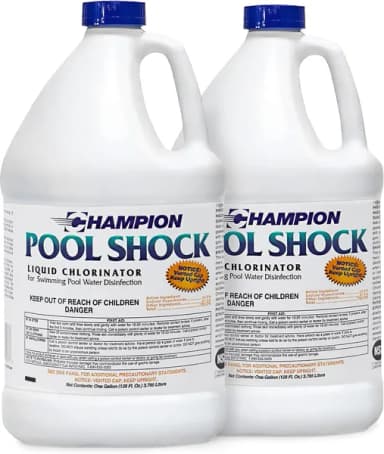
Champion / CPDI Liquid Chlorine 12.5%, 1 Gal 2-Pack
12.5% sodium hypochlorite. At shock volume the by-product matters more than the price — this is the only common form that leaves neither calcium nor cyanuric acid behind.
$36.99 · 1,542 reviews
Choosing a form
What each kind of shock leaves in your water
A shock dose is five to ten times a routine correction, so the by-product that is a rounding error at 1 ppm is not one at 25. This is the part of the decision the packaging does not help with.
Cal-hypo is the default, and reasonably so: it is cheap per ppm, stores well as a solid, and dissolves fast enough to shock with. It adds roughly 0.7 ppm of calcium hardness for every 1 ppm of free chlorine. In soft water that is doing you a favour. On hard tap water, or in a pool where calcium is already high, a few big cal-hypo shocks a season is how you arrive at scale on the tile and a cloudy pool you cannot explain.
Liquid chlorine adds nothing that accumulates — about 1.7 ppm of ordinary salt per ppm of chlorine, which no pool will ever notice. It is the right choice for large or repeated doses. The trade-off is that it degrades in storage, faster when warm, so a jug that has sat in a hot garage for a month is weaker than its label and you will find that out mid-shock.
Dichlor dissolves quickly and is convenient, and at shock volume it is usually the wrong answer. It adds about 0.9 ppm of cyanuric acid per ppm of chlorine — more per ppm than tablets do. A single 25 ppm shock with dichlor adds over 20 ppm of CYA, permanently raising every target you will chase afterwards, including the shock target itself. Its honest use is a new fill that needs stabiliser anyway.
Tablets are not a shock product at all. Trichlor is engineered to dissolve over days, which is the whole point of the format, so it cannot deliver a large dose quickly no matter how many you put in. The full comparison of the four forms covers what each is genuinely for.
A gap in the data
The best-selling shock on Amazon won’t tell you its strength
When we pulled the shock listings for this site in August 2026, the volume leader by a wide margin — around 20,000 units sold in a month, over 14,000 reviews — states its available chlorine nowhere. Not in the title, not in the description, not in the specification table. It says “Cal Hypo Formula” and stops.
That is a problem, not a quibble. Cal-hypo is sold between roughly 65% and 73% available chlorine, and that spread is a 12% swing in the dose. Without the figure you cannot compute anything; you can only follow the bag’s instruction and hope your pool is the one it was written for.
So the calculator above defaults to 65%, the figure the products we could verify actually publish — and we would rather tell you that than quietly pick a number. There is a second trap in the same aisle worth knowing: a percentage in an Amazon title very often is not a concentration at all. One popular shock advertises “90%” on the front, and that 90% refers to the share of pool problems the manufacturer says it solves. Others use it for fume reduction. Read the description, not the headline.
Where a product does publish a real available-chlorine figure, note that it is usually lower than the compound percentage shouted on the front — one tub we checked says 68% cal-hypo on the label and 65% available chlorine in the description. Dosing uses the smaller number. Using the larger one overdoses you by the difference.
Doing it properly
How to actually run a shock
Test first, and test all three. Free chlorine, total chlorine and CYA. Two of those three decide the target and the third decides the dose, so a shock run that starts without them is a guess.
Balance pH before you dose, not after. Chlorine is far more active in slightly acidic water than alkaline, so shocking at a high pH wastes a meaningful part of what you add. Somewhere near the lower end of the normal range is where a shock does its best work.
Add it after sundown with the pump running, unless you are fighting algae and re-dosing through the day. Pour liquid slowly around the perimeter of the deep end. Pre-dissolve granular product in a bucket of pool water unless the label says otherwise, because undissolved granules resting on a vinyl liner will bleach it. Never add any chlorine product through the skimmer, and never mix two chlorine products in the same container — that is one of the few genuinely dangerous things you can do at a residential pool.
Then re-test, and know what a zero means. Give it at least one full turnover — four to eight hours for most pools — before trusting a reading. Very high chlorine bleaches DPD reagent, so a sample can flash pink and go clear, reading as zero. Straight after a shock dose, a zero almost always means the opposite of what it looks like. Dilute the sample rather than adding more chemical.
If you are clearing algae, you are finished when three things are true at the same time: the water is clear, combined chlorine is under 0.5 ppm, and the level holds overnight without falling. All three, not two.
The reading this page can’t work without
Most test strips cannot give you combined chlorine
Combined chlorine is a difference — total minus free — so measuring it requires two separate readings. A strip with a single chlorine pad returns one number and therefore cannot produce a difference at all, whatever the box says. A DPD drop kit reads free chlorine first, then total after a second reagent, and the gap between them is the number this page needs — what that gap is telling you is worth understanding before you dose anything.
The same kits are also the ones that read cyanuric acid by drop test, and CYA is the reading that sets your shock target. Buyers cross-checking strips against drops have reported strips showing 0 against an actual 40–50 ppm. Which kit you need takes four taps, and the levels chart shows where every reading should sit.
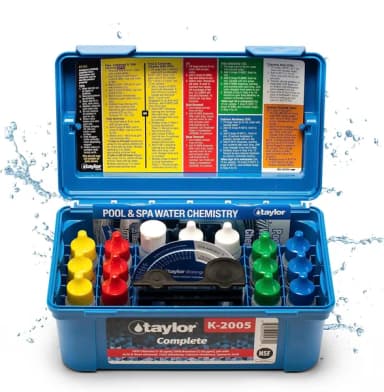
Where this leaves you
A shock dose needs two chlorine readings and a CYA
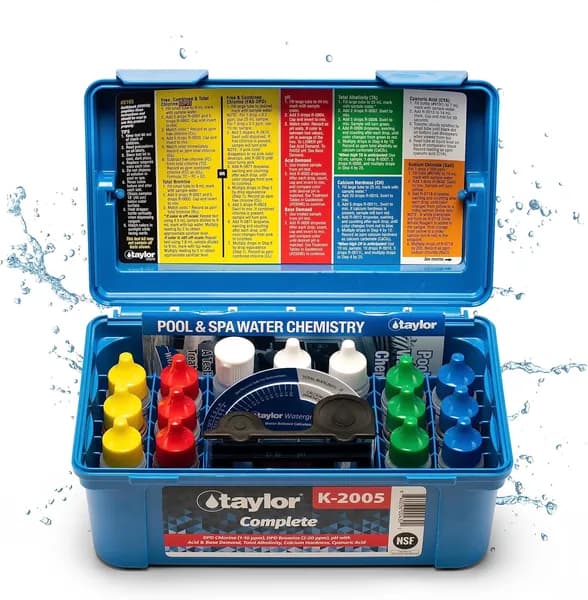
- Reads free and total chlorine separately — the difference is what you shock against
- Reads cyanuric acid by drop test, which sets how high the shock target goes
- Also reads calcium hardness, the number cal-hypo shocks quietly raise
- Reagents are sold individually, so one expired bottle is not a new kit
We have not tested this kit ourselves. It is the cheapest kit we track that reads both CYA and total chlorine by drops — and if you only ever test routinely, the decider on our test-kit page will send you to $11.99 strips instead.
Follow-ups