Chemistry · Updated 18 August 2026
How to raise pH and alkalinity in a pool
Both products on the shelf raise both readings. Which one you need, how much, and in what order depends on your water — and sometimes the answer is no chemical at all.
Raise pH and alkalinity calculator
Your pH, alkalinity and stabiliser together — because each product moves both readings.
Alkalinity target 80 ppm. Salt cells push pH up, so salt pools run lower on purpose.
Start with baking soda, not pH Up. Add 8 lb 1.1 oz to take alkalinity from 50 to 80 ppm. Raising pH in water with no buffer is why low pH keeps coming back: it holds until the next acidic input and swings straight down again. The baking soda alone lifts pH to about 7.16. If a re-test after six hours still reads under 7.2, add 5.3 oz of soda ash — worked out from the water after the baking soda, not from the reading you started with. Do not add it before that re-test: pH is still climbing on its own.
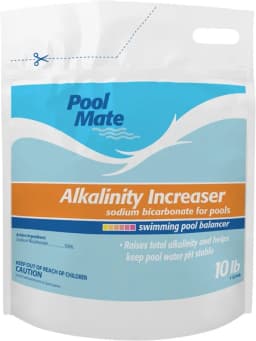
Pool Mate Alkalinity Increaser, 10 lb
Stated on the listing as 100% sodium bicarbonate, with a printed dose that matches this calculator to within 2%. It is the same chemical as grocery-store baking soda — buy whichever costs less per pound where you are.
$17.61 · 4.7★ · 1,282 reviews
The short version
Two products, one acid, and the ratio is the whole difference
Most advice on this question comes in two halves that never meet: use baking soda to raise alkalinity, use pH Up to raise pH. Neither half is wrong. But treating them as two separate jobs is how people end up chasing their water around for a fortnight, because each of those products moves both readings, and how far depends on what is already in the pool.
Baking soda is sodium bicarbonate. pH Up is soda ash, sodium carbonate. They are two salts of the same weak acid, and each one adds two things to your water: carbon, and alkalinity. The only real difference between them is the proportion. Baking soda adds one unit of alkalinity for every unit of carbon. Soda ash adds two.
That ratio is what pH responds to. Pool water already holds its alkalinity and carbon in roughly the one-to-one proportion baking soda delivers, so adding baking soda changes the amount of both without much changing the balance between them — alkalinity rises, pH barely moves. Soda ash tips the balance hard toward carbonate, so pH jumps for a comparatively small alkalinity gain. That is why one is the right tool for raising alkalinity and the other is the right tool for raising pH, and it is also why using the wrong one does not simply fail. It overshoots the reading you were not trying to change.
There is a third lever that almost never gets mentioned alongside the other two, and it is free. Aeration raises pH by letting dissolved carbon dioxide escape, and it does that with zero change to alkalinity. Once you see the three side by side — one moves mostly alkalinity, one moves mostly pH, one moves only pH — the question of what to add stops being guesswork. The calculator above picks between them from your readings.
The part nobody computes
“6 oz raises pH 0.2” is only true at one alkalinity
The rule of thumb you will find repeated everywhere is that six ounces of soda ash raises pH by about 0.2 in 10,000 gallons. It is not a made-up number. It is just a number with a hidden condition attached, because the amount of pH movement you get from a dose depends on how much buffer is already in the water — and the buffer is your alkalinity. Here is the same six-ounce dose, from the same starting pH of 7.2, in pools that differ only in their alkalinity and stabiliser:
| Alkalinity | pH after, no CYA | pH after, CYA 40 |
|---|---|---|
| 50 ppm | 7.41 | 7.34 |
| 80 ppm | 7.32 | 7.30 |
| 120 ppm | 7.28 | 7.27 |
The rule is exactly right for an unstabilised pool at alkalinity 50. In a typical outdoor pool at alkalinity 120 with stabiliser in it, the same dose does well under half as much. Nothing about the product changed. The water did.
The same thing catches out single-dose instructions. One soda ash listing we checked tells readers that a pound per 10,000 gallons “is all you will need” to fix low pH. Run it through the chemistry from a starting pH of 7.0 at CYA 40 and that pound lands you at 7.3 if your alkalinity is 50, at 7.2 if it is 80, and at 7.14 — still under the floor — if it is 120. A fixed dose is a guess about your alkalinity that the label does not tell you it is making.
Stabiliser matters for a less obvious reason too. A total alkalinity test counts cyanuric acid as if it were alkalinity, because at pool pH a large share of it is in a form the titration reacts with. At pH 7.5 roughly a third of your CYA reading shows up in your alkalinity reading — about 13 ppm of a pool’s TA at CYA 40 is not carbonate at all. It also buffers pH on its own. So the calculator asks for CYA even though no product on this page contains any, and a manufacturer dose table that ignores it will under-dose a stabilised pool.
Pool Mate Alkalinity Increaser, 10 lb
Stated on the listing as 100% sodium bicarbonate, and its printed dose matches the chemistry on this page to within 2%. Same chemical as grocery baking soda — compare the price per pound and buy whichever is cheaper.
$17.61 · 1,282 reviews
Why pH keeps going up
Your pool is heading for a pH, and alkalinity decides which one
If you have ever lowered pH on Saturday and found it back up by Wednesday, the pool was not misbehaving. It was going home. Water exchanges carbon dioxide with the air above it, and at a given alkalinity there is exactly one pH at which the two are in balance. Below that pH, the water holds more dissolved CO₂ than the air does, so it slowly gives it up — and losing CO₂ raises pH without touching alkalinity. The pool keeps climbing until it reaches that balance point.
What makes this useful rather than just interesting is that the destination is set by alkalinity. Worked out against the CO₂ in ordinary outdoor air, at CYA 40:
| Alkalinity | pH it drifts toward |
|---|---|
| 60 ppm | 8.1 |
| 80 ppm | 8.3 |
| 100 ppm | 8.4 |
| 120 ppm | 8.5 |
| 150 ppm | 8.6 |
Every row is above the 7.8 top of the acceptable range, which is why pH drift is upward in nearly every pool. And every extra ten or twenty ppm of alkalinity nudges the endpoint higher. That is the real cost of overshooting when you raise alkalinity: not a bad reading today, but a pool that climbs toward a higher pH, faster, forever after — and one that takes more acid to hold down. It is the reason this page raises alkalinity to the target rather than comfortably past it, and the reason salt pools, whose cells stir CO₂ out of the water constantly, are run at a lower alkalinity target of 70.
Two honest caveats. These endpoints are estimates, because the CO₂ just above a pool surface is not exactly the CO₂ of open air. And many pools never get there, because something acidic keeps pulling them back down: trichlor tablets above all, which is why tablet-fed pools are the ones that need baking soda over and over. How many tablets your pool needs covers the other cost of those tablets, the stabiliser they leave behind. Read the table as a direction and a ceiling rather than a forecast.
The drift matters for chlorine as well as for comfort. As pH rises, a smaller share of your free chlorine is in its strong form — about 69% at pH 7.2 but only about 26% at pH 8.0, for exactly the same test-kit reading. Clearing a green pool works through what that curve does to a shock that seems to stop working.
Worked example
Both readings low: why the order changes the shopping list
19,200 gallon chlorine pool, stabiliser at CYA 40. The test reads pH 7.0 and total alkalinity 50 ppm — both low, the classic state of a pool that has been on trichlor tablets all summer.
- 1Alkalinity targetThe floor of the ideal band for a chlorine pool — a 30 ppm shortfall80 ppm
- 2Baking soda to reach itPure stoichiometry: 1 lb 6.4 oz per 10 ppm per 10,000 gallons, scaled8 lb 1.1 oz
- 3pH after the baking soda aloneUp from 7.0 without a single ounce of pH Up7.16
- 4Soda ash still needed, if a re-test confirms itWorked out from the water after the baking soda, not from the original reading5.3 oz
- 5If you had used soda ash for the alkalinity insteadEnough to reach alkalinity 80 — and it takes pH to about 8.345 lb 0.1 oz
The branch that sells nothing
Low pH with healthy alkalinity: do not reach for soda ash
There is one combination where the product on every “how to raise pH” page is the wrong answer, and it is not rare: pH is low, but alkalinity is already fine or high. Water in that state is not short of buffer. It is holding a large excess of dissolved carbon dioxide — at pH 6.6 and alkalinity 100, roughly sixty-six times what water in balance with the air would hold.
Soda ash will raise that pH. The way it does so is by reacting with the excess CO₂ and turning it into bicarbonate, which is to say, into alkalinity. For a 19,200 gallon pool at pH 6.6, alkalinity 100 and CYA 40, getting back to 7.2 with soda ash takes 11 lb 4 oz and leaves alkalinity at 166 ppm. You fixed a low pH and bought a pool whose alkalinity is far over the ceiling, whose pH will now climb toward 8.5 and above, and which will take a lot of acid to bring back.
The alternative costs nothing. Let the CO₂ out. Turn the return jets upward so they break the surface, run any waterfall, fountain or spa spillover, and run the pump for longer than usual. Surface agitation is the whole mechanism, so the more of the water surface you can disturb, the faster it goes. pH rises, alkalinity stays exactly where it is, and the only thing to watch is that you stop when you reach range — re-test once a day. The calculator sends this reading to aeration and shows the soda ash dose it refused, so the trade is visible rather than hidden.
Soda ash is the right call for low pH when alkalinity is adequate and the dose leaves it in range — a pool at pH 7.0 and alkalinity 90, for example, needs 2 lb 2.3 oz in 19,200 gallons and finishes at alkalinity 103, comfortably inside the band. The calculator draws the line at the top of the acceptable alkalinity range for your pool type. It also aims soda ash doses at pH 7.2, not the middle of the range, because water below its drift point keeps rising on its own — and every extra ounce adds alkalinity you did not ask for.
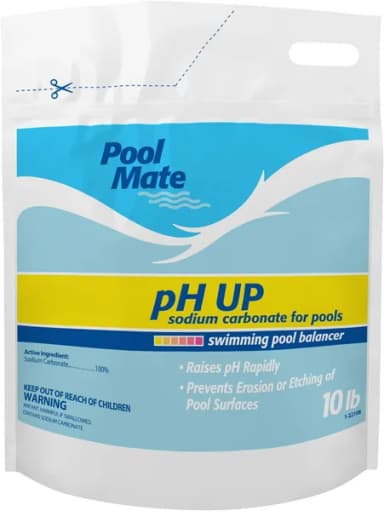
Pool Mate pH Up, 10 lb
Stated on the bag as 100% sodium carbonate — soda ash, the chemical the pH doses on this page are calculated for. The listing does not print its dose chart, which is one more reason to use the calculator rather than a fixed scoop.
$22.49 · 2,693 reviews
Adding it
How to add baking soda and soda ash without making the water worse
One chemical at a time, pump running. Never add baking soda or soda ash in the same session as chlorine or acid, and never mix any of them together in a bucket. Give each addition several hours of circulation before you test again, or you will be reading a pocket of water that has not mixed yet.
Baking soda can go straight in. Broadcast it across the deep end rather than dumping it in one spot, and brush any that settles. Large doses are fine in one go, but for anything over the calculator’s figure for a 20 ppm rise it is worth splitting the dose across two sessions so you can check you are heading where you expected.
Soda ash should be pre-dissolved. Stir it into a bucket of pool water and pour it around the edges with the pump on. Added dry, it creates a small zone of very high pH where it lands, and in water with a fair amount of calcium that zone throws calcium carbonate out of solution — a brief milky cloud that people reasonably mistake for a new problem. If that is what you are looking at, why a pool goes cloudy covers the calcium case. Add half the soda ash dose, re-test, then decide on the rest.
Test with something that can resolve the numbers you are acting on. A strip that reads alkalinity in wide colour bands is fine for knowing roughly where you are, but the doses on this page scale directly with the size of the shortfall, and a strip misread by 20 ppm is a couple of pounds of baking soda in an average pool. Strips that have been stored in heat are worse — one buyer found theirs reading pH 7.0 against a true 7.4, and alkalinity nearly 100 ppm high, confirmed against a liquid kit. A titration kit counts alkalinity in 10 ppm drops, which is the resolution this calculator is built around. Which test kit reads what compares them.
What this page cannot tell you
The limits, stated plainly
We have not put these products in a pool and do not claim to have tested them in water. The doses above come from the molar masses of the two chemicals and the published chemistry of carbonate buffering, and we checked them against what manufacturers print. The baking soda figure agrees with a manufacturer label to within 2%. The soda ash model agrees with one manufacturer’s own dose table to within about 5% at two of its four settings, and we record where it disagrees rather than quietly tuning it to match.
The pH predictions are the reading immediately after a dose, before the pool has exchanged any CO₂ with the air. In practice pH usually keeps rising afterwards, which is why the doses aim low and why every instruction here says re-test before adding more. The model does not include borates, so a pool treated with a borate product will move less than it predicts. It does not correct for water temperature, which shifts these figures by less than a test kit can read. And it cannot tell whether your test kit is right, which matters more than any of those.
We also do not calculate an acid dose, anywhere on this site. Lowering pH or alkalinity takes acid, and pool acids are sold at strengths their listings often do not state — low-fume muriatic acid is commonly about half the strength of standard without saying so plainly. A dose built on a guessed strength is not safe to publish. For bringing a high pH down, for borate pools, and for water that refuses to behave the way these numbers say it should, the TroubleFreePool forum will work through your actual readings with you. The pool chemical levels chart has every target this page refers to in one place.
Questions
Raising pH and alkalinity, answered with the numbers
Where this leaves you
Every dose on this page scales with a reading — so the reading has to be right
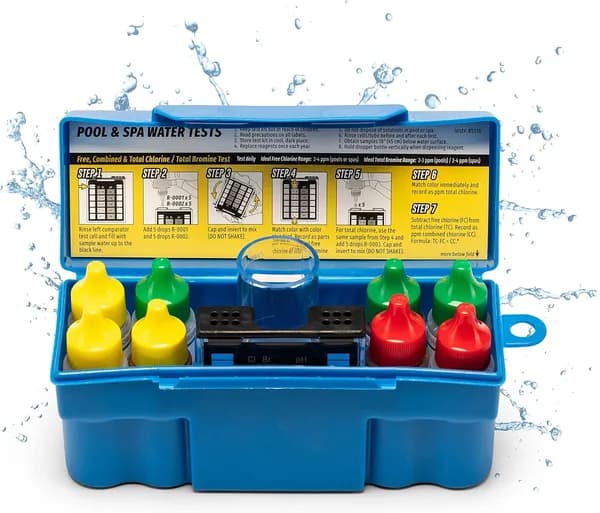
- Titrates total alkalinity in 10 ppm drops, the resolution the baking soda dose is built on.
- Reads pH on a comparator rather than a strip pad, so a heat-damaged strip cannot send you after a problem you do not have.
- Splits free from total chlorine as well, which the rest of this site's calculators use.
- The cheapest kit we track that titrates alkalinity rather than estimating it from a colour.
It does not read cyanuric acid, which this calculator also asks for. CYA changes these doses modestly rather than decisively, so a strip reading of CYA is good enough here — the test-kit decider covers kits that read all of it in one box.
Working on a different part of the same problem? How much chlorine to add handles routine dosing, liquid vs tablets vs granular compares the chlorine forms themselves, and free vs total chlorine explains the readings your kit gives you.