Chemistry · Updated 18 August 2026
How much chlorine should you add?
Two readings and your pool size. We work out the target first, because the number on the bottle is only right for one CYA level.
How much chlorine should you add?
Your target isn't 3 ppm. It depends on your CYA — so we work that out first.
At CYA 40 your free chlorine should sit at 4.6 ppm, and you are reading 1. Add 70.7 fl oz of liquid chlorine (12.5%) to 19,200 gallons, with the pump running, and re-test in a few hours.
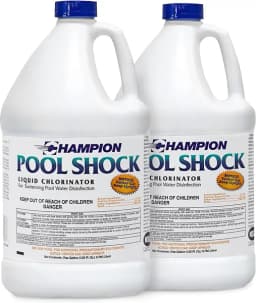
Champion / CPDI Liquid Chlorine 12.5%, 1 Gal 2-Pack
12.5% sodium hypochlorite — the strength this dose was calculated from. Adds no CYA and no calcium.
$36.99 · 4.6★ · 1,542 reviews
Why every other answer is a guess
The target moves. That’s the whole problem.
Almost every answer to this question online gives you a fixed number — 1 to 3 ppm, usually — and then a dosing table. The table is fine. The fixed number is the problem, because chlorine’s strength is a ratio, not an amount.
Cyanuric acid binds most of the chlorine in your water and holds it in reserve. That is genuinely useful — without it, sunlight would strip an unprotected pool in hours. But bound chlorine is not working chlorine, so the more CYA you have, the more total chlorine you need to keep the same amount actually doing its job. At CYA 30 you need about 3.5 ppm. At CYA 100 you need around 11 ppm for the same effect.
This is why people dose “correctly” all season and still get algae in water that tests fine. They are hitting a number that was right in June and stopped being right as their tablets pushed CYA upward every week.
Getting it right
Dose in the evening, with the pump on
Sunlight destroys unstabilised chlorine fast, so a large dose added at midday loses a meaningful share of itself before it does any work. Add it after sundown with the pump running and you get the whole night to circulate.
Add liquid slowly around the perimeter of the deep end rather than in one spot, and never pour any chlorine product through the skimmer — if it meets anything acidic in the plumbing you have created a genuine hazard. Granular products should be pre-dissolved in a bucket of pool water unless the label says otherwise, because undissolved granules sitting on a vinyl liner bleach it.
Then re-test. A dose you did not verify is a guess with extra steps, and which form you used changes what else it left behind.
Worked example
A pool that tests fine and turns green anyway
A 20,000 gallon pool in July. The owner has dosed to 3 ppm all season, exactly as the bottle says, and the water has just gone cloudy.
- 1Free chlorine readingRight where the label says it should be3.0 ppm
- 2CYA reading, first test of the seasonNever tested before — tablets all summer95 ppm
- 3Minimum free chlorine at that CYA7.1 ppm
- 4Actual target10.9 ppm
- 5How far below minimum they have been-4.1 ppm
- 6Liquid chlorine to reach target1 gal 34 fl oz
Nothing went wrong on the day the pool turned. This owner had been running below the minimum for weeks while every test told them they were fine — because the test was measuring the right thing against the wrong target.
This is the single most common way a well-maintained pool fails, and it is invisible without a CYA reading. The 3 ppm on the bottle was never wrong exactly; it was written for a pool at CYA 30, and tablets had quietly moved this one to 95.
When the number won’t move
Three reasons a dose does nothing
1. Demand is outrunning you. If algae is established or the water is carrying a lot of organics, chlorine is being consumed as fast as you add it. The test reads low not because the dose failed but because it was eaten. The fix is not a bigger single dose — it is holding shock level over days, re-testing and re-dosing, until the level finally holds overnight.
2. Your chlorine is old. Liquid chlorine degrades in storage, faster when warm, and a jug that has sat in a hot garage for a month can be meaningfully weaker than the label. If your usual dose stopped working and nothing else changed, suspect the jug. This is the main practical argument for buying it in smaller quantities more often.
3. You are dosing against the wrong target. Covered above, and it is the most common of the three. Before concluding anything is wrong with the pool or the product, confirm CYA with a drop test.
One thing that is not on this list: the pool being “too big for chlorine to work.” Volume changes the dose, never the outcome.
If more than one reading is out at once, correct them in order — the levels chart explains the sequence and why doing it out of order means chasing your tail.
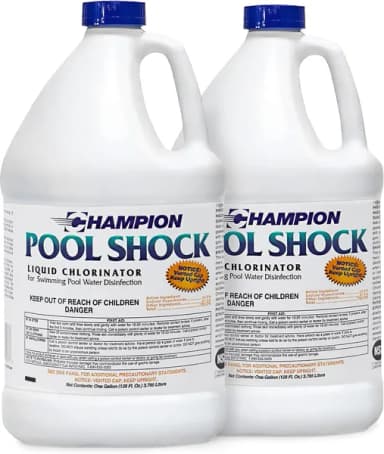
Champion / CPDI Liquid Chlorine 12.5%, 1 Gal 2-Pack
12.5% sodium hypochlorite — the form that adds no cyanuric acid and no calcium, so a heavy week costs you nothing permanent.
$36.99 · 1,542 reviews
Your demand isn’t national
How much you lose a day depends on where you are
The calculator above asks for your current reading rather than your daily loss, because that is what you can measure today. But the figure that decides how often you are back here dosing is daily chlorine loss, and it is largely a function of UV and season length — which is to say, geography.
A pool in the desert Southwest can lose double what a Pacific Northwest pool loses on the same day, and runs that demand for three times as many weeks a year. Use the regional figures below as a starting point, then measure your own: test in the evening, test again 24 hours later, take the difference.
Where's your pool?
Season length and UV load are the two biggest drivers of chlorine demand, and both are geographic.
A 20,000 gallon pool here loses roughly 3.8 ppm of chlorine a day at peak, across a 44-week season. Run that entirely on trichlor tablets and you would finish around 732 ppm of cyanuric acid from a starting point of 40 — which is why the same tablet routine behaves completely differently in gulf & southeast than it does two time zones away. Your free chlorine target would move from 4.6 ppm to 84.2 ppm over that season.
If you overshoot
What actually happens when you add too much
Far less than people fear. The level used to clear an algae bloom is several times a normal target and is still considered swimmable, so an accidental double dose is a nuisance rather than an emergency. What you do about it depends on how far over you went.
Moderately over — say double your target. Do nothing. Take the cover off, run the pump, and let sunlight bring it down; an uncovered pool sheds chlorine quickly, especially at low CYA. It will usually be back in range within a day.
Substantially over. Same answer, more patience, and stay out until it comes down — not because a high reading is dangerous to touch, but because at very high levels chlorine is hard on swimwear, hair and vinyl. Nobody needs to drain a pool over this.
The real cost of overshooting is not safety, it is collateral chemistry. If you overshot with cal-hypo you have also added calcium you cannot remove, and if you overshot with tablets or dichlor you have added cyanuric acid you cannot remove. The chlorine sorts itself out in a day. The passenger doesn’t.
Getting an honest reading back
When to re-test, and why the first reading lies
Test too soon after dosing and you are not measuring your pool, you are measuring the plume of chemical that hasn’t mixed yet. Give it at least one full turnover with the pump running — for most residential pools that is somewhere between four and eight hours — before you trust a number.
There is a second reason to wait that catches people during algae recovery. Very high chlorine bleaches DPD reagent: the sample flashes pink and then goes clear, which reads as zero. A reading of zero immediately after a heavy dose almost always means the opposite of what it appears to. Dilute the sample or wait, rather than adding more.
And take your reading at the same time of day when you are tracking a trend. Chlorine falls through the daylight hours and holds overnight, so an evening reading compared against a morning one will look like a loss that never happened.
The dependency nobody mentions
All of this rests on one reading you probably can’t trust
Every number on this page is derived from your CYA, and CYA is the reading test strips are worst at. Buyers who cross-checked strips against a drop kit found strips reporting 0 against an actual 40–50, and in the worst account we came across, strips missed a level over 220 ppm entirely.
If your CYA number came off a strip, treat every dose on this page as provisional until you have confirmed it with drops. Which kit you need takes four taps.
Where this leaves you
Every number on this page starts with one reading
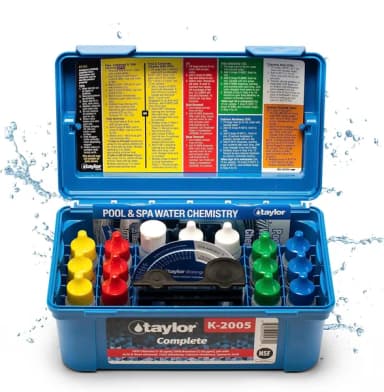
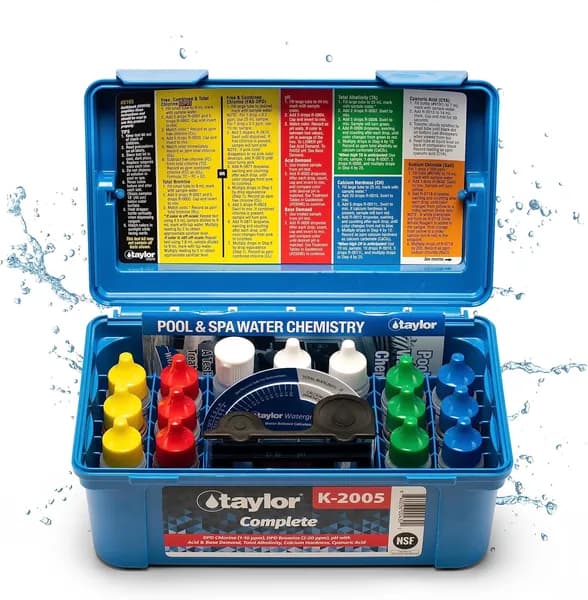
- Reads cyanuric acid by drop test — the reading that sets your chlorine target
- Separates free from total chlorine, so you can see chloramines rather than guess
- Also reads calcium hardness, the other number that only moves one way
- Reagents are sold individually, so one expired bottle is not a new kit
We have not tested this kit ourselves. It is the cheapest kit we track that reads CYA by drops rather than a colour band — see our editorial policy for how picks are made.
Follow-ups