Chemistry · Updated 18 August 2026
How to clear a green pool
Almost nobody fails at this because they used the wrong chemical. They fail because they added the right one once, at a pH that had already disarmed it.
What will it take to clear your green pool?
The level to hold, how long to hold it, and roughly how much chlorine the whole job needs.
Floor visible but blurred, distinctly green throughout.
At CYA 40 the level that kills algae is 16 ppm. You are reading 0, so the first dose is 2 gal 58.4 fl oz into 19,200 gallons — but that dose is the start, not the job. Cloudy green water typically takes 2–5 days at that level, consuming roughly 8–15 ppm a day. Budget 4 gal 116.9 fl oz to 13 gal 124.3 fl oz for the whole clear-up.
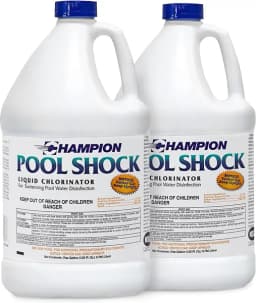
Champion / CPDI Liquid Chlorine 12.5%, 1 Gal 2-Pack
12.5% sodium hypochlorite — the figure this plan is calculated from. At clear-up volume it is the only form that leaves nothing behind: no cyanuric acid to raise next season's target, no calcium to scale.
$36.99 · 4.6★ · 1,542 reviews
The short version
Clearing a pool is a level you hold, not a dose you add
A green pool is a pool where algae is reproducing faster than the chlorine can kill it. That framing matters, because it tells you what winning looks like. You are not trying to deliver a quantity of chemical; you are trying to keep the water continuously hostile for long enough that nothing survives it. The moment the chlorine level drops, the surviving algae starts multiplying again, and it multiplies fast enough to undo a day of work overnight.
This is why the single most common experience in this whole subject is “I shocked it and it went a bit better, then it came back.” Nothing went wrong chemically. The dose worked, the algae consumed it, and by morning there was nothing left in the water. A bloom in an opaque pool can eat fifteen to twenty-five parts per million of free chlorine in a day — five to eight times a normal pool’s entire daily demand. Against that, one bag of shock is a snack.
So the plan has three parts, and only the first is what people usually think of. Raise free chlorine to the level that kills algae in your water. Hold it there for days by testing and re-dosing, not once but several times a day. And run the filter continuously the whole time, because killing algae and removing algae are two different jobs and only one of them is chemistry.
The failure this page exists for
Your pH decides how much of your chlorine is real
Here is the situation that sends people to search engines in genuine confusion: the test kit reads a high chlorine number and the pool is still green. It looks like the chemistry has stopped obeying the rules. It has not. The chlorine is there, it is simply in the wrong form.
Chlorine dissolved in water exists as two species that exist in balance with each other — hypochlorous acid and hypochlorite ion. A test kit counts both of them together and calls the sum “free chlorine”. But they are not equally useful. Hypochlorous acid is electrically neutral, passes through a cell wall easily, and does nearly all of the actual killing. Hypochlorite ion carries a negative charge, is repelled by the likewise negative surface of an algae cell, and is a much weaker disinfectant.
What decides the split between them is pH, and it does so steeply, right across the narrow range a swimming pool actually lives in:
| Your pH | Free chlorine in the strong form | Killing power vs pH 7.2 |
|---|---|---|
| 7.0 | 77.6% | 113% |
| 7.2 | 68.6% | 100% |
| 7.5 | 52.3% | 76% |
| 7.6 | 46.6% | 68% |
| 7.8 | 35.5% | 52% |
| 8.0 | 25.7% | 38% |
| 8.2 | 18.0% | 26% |
Read the last column again, because it is the whole point of this page. A pool at pH 8.2 gets about a quarter of the result that the identical chlorine reading delivers at pH 7.2. Fifteen parts per million at 8.2 is doing roughly what four parts per million does at 7.2 — and the test kit prints the same 15 either way. The reader is not imagining the contradiction between their reading and their water. They are looking at a number that is true and irrelevant.
And a green pool drifts upward on its own, which is what makes this a trap rather than an oversight. Algae consumes carbon dioxide from the water during daylight, and removing carbon dioxide raises pH. So the bloom pushes the pH up, the rising pH disarms the chlorine, and the weakened chlorine lets the bloom grow. Nobody made a mistake; the pool simply found a loop and settled into it.
This is why the calculator above asks for your pH before it asks what you plan to pour in, and why the order of operations is not negotiable. Getting pH down to about 7.2 costs one bottle of acid and roughly doubles the effect of every dose that follows it. Doing it afterwards means paying for the chlorine twice.
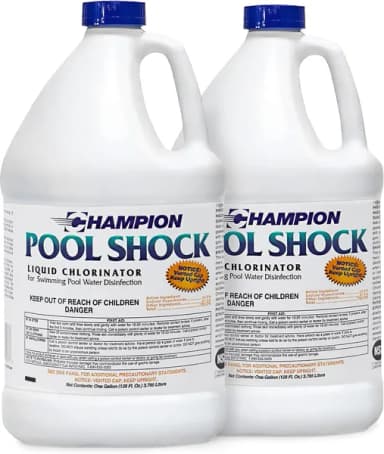
Champion / CPDI Liquid Chlorine 12.5%, 1 Gal 2-Pack
12.5% sodium hypochlorite — the strength this page's doses are calculated from. At clear-up volume it is the only common form that leaves nothing behind: no cyanuric acid to raise next season's target, no calcium to scale.
$36.99 · 1,542 reviews
The second half of the answer
Severity does not change the target. It changes the bill
There is a persistent idea that a worse pool needs a higher chlorine level. It does not, and following that instinct is actively harmful. The level that kills algae is set by your cyanuric acid and nothing else, because cyanuric acid is what binds chlorine into a reserve and decides how much of it is free to work at any moment. A light green tint and a black swamp are both cleared at the same parts per million if they have the same stabiliser reading.
Scaling the target with severity produces two errors at once. On a mild bloom it suggests a level far above what is needed, and on a mild bloom people therefore decide the whole approach is overkill and use less. On a severe one it suggests the chemistry is different when it is identical. What severity actually changes is the two things that cost money and time:
| What you can see | Chlorine eaten per day | Days at level |
|---|---|---|
| Green tint — floor fully visible | 4–8 ppm | 1–3 days |
| Cloudy green — floor visible but blurred | 8–15 ppm | 2–5 days |
| Opaque green — cannot see the bottom step | 15–25 ppm | 4–8 days |
| Swamp — black or brown, surface film | 25–40 ppm | 7–14 days |
Those daily figures are planning estimates, not measurements, and this page would rather say so than dress them up. How fast a bloom consumes chlorine depends on water temperature, sunlight, phosphate load and how long it has been running, and no honest source publishes a validated national number for it. They exist here to answer a question that genuinely cannot be answered otherwise before you start — roughly what is this going to cost, and is that more than replacing the water?
They are also superseded within a day, by a test you can run yourself. Chlorine consumption is directly observable: test free chlorine at sundown, test again after dark, and the drop is your pool’s real number. From day two onwards you should be budgeting against that instead of against the table. The same test is the finish line — when the overnight drop reaches roughly nothing, the algae is dead, and everything after that is the filter’s job.
Worked example
A 20,000 gallon pool, cloudy green, that has already been shocked twice
Free chlorine reads 0. Cyanuric acid is 40. pH is 8.0 — which is where a green pool usually sits, because the algae has been raising it. The owner has already put two bags of shock in over a week and the water is no better.
- 1The target is 16 ppm of free chlorineSet by CYA 40, not by how green it is. The bag's 1 lb per 10,000 gallons delivers about 7.8 ppm — under half of it.16 ppm
- 2At pH 8.0, only 25.7% of free chlorine is the active formThat is 38% of the killing power the same reading would have at pH 7.2. Both previous shock doses were working at roughly a third strength.38%
- 3Lower pH to about 7.2 first — before any more chlorineThis is the cheapest step in the whole job and it changes the value of every dose after it.1 step
- 4First dose: 2 gal 71.5 fl oz of 12.5% liquid chlorineRaises free chlorine from 0 to 16 ppm in 20,000 gallons.2.6 gal
- 5Then hold 16 ppm for 2–5 days, re-dosing several times dailyThis is the part the two previous shock doses skipped entirely.8–15 ppm/day
- 6Total chlorine for the whole clear-up: 5 to 15 gallons32 to 91 ppm of free chlorine in total, initial dose included. Roughly three to eight times what was bought so far.5–15 gal
When chlorine is the wrong answer
Two pools this calculator will tell you not to treat
The first is a pool with very high cyanuric acid. Because the target scales with stabiliser, a pool at CYA 100 has to hold 40 ppm of free chlorine for days — and every single top-up is sized against that number. In a 20,000 gallon pool that is somewhere between 15 and 38 gallons of liquid chlorine, and one lapse in the middle returns you to the start.
Be precise about what draining fixes there, because it is easy to oversell. It does not make the algae consume less; the bloom eats roughly what it was always going to eat. What it changes is the level you are trying to hold, which falls from 40 ppm to something you can realistically hit several times a day without a pallet of chemical, and it removes the punishing target permanently rather than for one week. Working out how much water to replace takes one reading and no products at all.
The second is a pool that is green but clear. If you can see the floor perfectly and the water simply has a green or brown cast to it, that is very probably dissolved metal — copper or iron from fill water, a corroding heater core, or a copper-based algaecide — and no amount of chlorine will fix it. Algae clouds water and makes surfaces slippery; metal does neither. Shocking a metal-stained pool commonly makes the colour worse, because oxidising dissolved metal is exactly what turns it visible. Everything on this page is for algae.
There is also a version of the “should I just drain it?” question worth answering carefully, because the internet answers it carelessly. A full drain is not a neutral option: an empty shell can float out of the ground where groundwater is high, and a vinyl liner can shrink and fail once it dries out. A partial drain and refill carries neither risk and achieves the thing that actually matters, which is dilution. If you are weighing water against chemical, weigh a partial one.
Before you start
The order that makes the difference
Brush everything first. Walls, floor, steps, and especially the shaded corners behind ladders. Algae attached to a surface is far better protected than algae suspended in water, and brushing is what moves it into the chlorine. This costs nothing and it is the step most often skipped.
Run the filter continuously. Not on a timer, not overnight only. Dead algae is extremely fine suspended material and the only thing that removes it is filtration; the chemistry can be finished a full day or two before the water actually looks clear. Expect to clean or backwash the filter repeatedly as pressure rises, and treat that as evidence it is working.
Fix pH, then chlorine, in that order. For the reasons above.
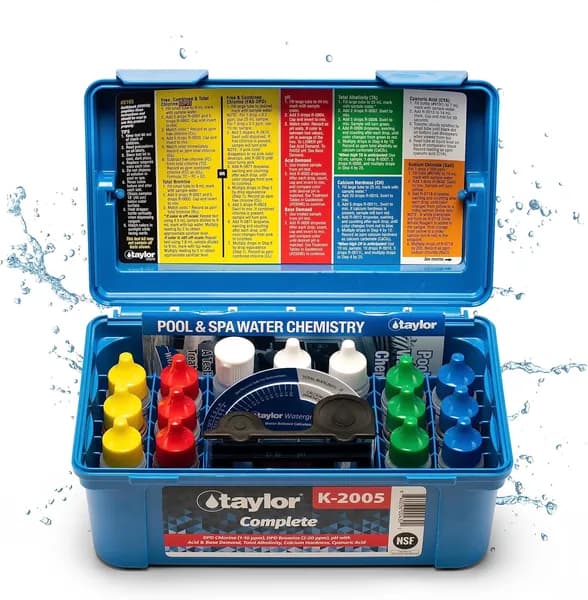
Test properly, and test often. This is the one place where equipment genuinely decides the outcome. Strips cannot read the levels involved here — most top out around 5 or 10 ppm, and you will be holding two to four times that, so a strip will read “high” identically at 12 ppm and at 30 and give you no way to tell whether you are on target or wasting money. You need a drop kit that reads high free chlorine by dilution and reads cyanuric acid, because without the CYA number the target itself is guesswork. Which kit does what covers the choice in full, and the free versus total chlorine reading explains what the second number tells you once the water starts clearing. If your water is clear and you only need a one-off shock level rather than a multi-day clear-up, the pool shock calculator is the simpler tool for that job.
What this page cannot tell you
The limits, stated plainly
We have not put a test kit in your pool, and this site does not claim to have tested any product in water. Everything above is arithmetic applied to your readings, plus published chemistry. That means there are real things it cannot see.
It cannot tell mustard algae from green algae, and mustard algae behaves differently — it tolerates ordinary chlorine levels, returns to the same shaded wall repeatedly, and needs a higher level held longer. It cannot see a filter that is failing, a pump that is not moving enough water, or a bloom being fed by phosphate from fill water or run-off. It cannot tell you whether your pH reading is accurate, which matters more here than anywhere else on this site. And the daily-loss estimates are, as said above, a budgeting tool rather than a measurement.
For any of those — and for a pool that will not clear after a week of doing everything right — the TroubleFreePool forum is where people will look at your actual numbers, in order, and tell you which one is lying. That is a thing a calculator cannot do and there is no point pretending otherwise.
Questions
Green pool questions, answered with the numbers
Where this leaves you
You cannot clear a green pool with a test strip
- Reads free chlorine well above 10 ppm by dilution — the range you will actually be holding for days.
- Reads cyanuric acid, which is the number that sets your target in the first place.
- Reads pH, the reading that decides how much of your chlorine is doing anything.
- Splits free from total chlorine, so you can tell a finished clear-up from a stalled one.
This is the one page on this site where we recommend the expensive kit rather than the cheap one, and the reason is narrow: a clear-up is the only job that needs high-range chlorine and CYA from the same kit on the same day. For routine weekly testing our decider still sends most people to $11.99 strips.