Chemistry · Updated 18 August 2026
How to lower cyanuric acid in your pool
There is one method that works predictably, and it isn’t a bottle. Put your numbers in and you’ll get the exact volume to replace.
How much water do you have to replace?
The only reliable way to lower CYA. There is no shortcut.
Drain and refill 11,520 gallons — 60% of your 19,200. CYA falls in direct proportion to the water you replace, because nothing else removes it.
Worth it for this reason: at CYA 100 you have to hold 11.5 ppm of free chlorine to stay ahead of algae. At 40 you only need 4.6 ppm — so the water you replace pays for itself in chlorine you stop buying.
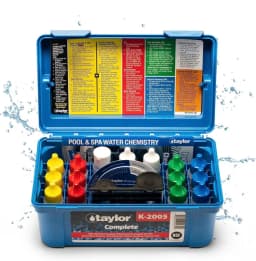
Taylor K-2005 DPD 9-in-1 Complete
Before you replace thousands of gallons, confirm the CYA number with drops. One buyer's strips missed a level over 220 ppm while reporting everything was fine.
$68.99 · 4.6★ · 3,624 reviews
The short answer
Dilution. Everything else is a maybe.
Cyanuric acid is not consumed by anything that happens in a swimming pool. Sunlight doesn’t break it down, sanitising doesn’t use it up, and it doesn’t evaporate — water evaporates and leaves the CYA behind, so topping off actually concentrates it a little. It leaves your pool when water leaves your pool, and essentially not otherwise.
That’s why the arithmetic above is unusually trustworthy for pool chemistry. Replace 40% of the water and CYA falls 40%. There is no reaction to go wrong, no temperature dependence, and nothing to overshoot.
Enzyme-based CYA reducers do exist. Reported results range from a real drop to no measurable change, they take weeks, and they usually want repeat doses. We’re not going to tell you they never work — we are going to tell you that you cannot predict the outcome before you spend the money, and you can predict dilution exactly.
Worth knowing how you got here, so it doesn’t happen again: chlorine tablets add CYA every single week — about 10 ppm of it if they’re your only chlorine, regardless of pool size.
Before you drain anything
Check whether you actually need to
High CYA is not poisonous and it is not an emergency. What it does is move the goalposts: the free chlorine you need is a function of the CYA you have. At CYA 30 you need about 3.5 ppm. At CYA 100 you need about 11 ppm for the same sanitising power — same pool, same water, three times the chlorine.
So the real question isn’t “is my CYA high,” it’s “is the chlorine I now need more trouble than replacing the water?” Work out your target first, then decide.
What should your chlorine actually be?
Not 3 ppm. It depends entirely on your CYA.
At CYA 50, never let free chlorine fall below 3.8 ppm. Aim for 5.8 ppm. If you are clearing an algae bloom you need 20 ppm and you need to hold it — not hit it once.
Above roughly 80 ppm your chlorine is still present but chemically asleep.
Taylor K-2005 DPD 9-in-1 Complete
Every number above depends on that CYA reading being right, and CYA is what strips get most wrong — buyers cross-checking found 0 against an actual 40–50. This reads it by drop test.
$68.99 · 4.6★ · 3,624 reviews
Worked example
Draining, or living with it? The arithmetic.
A 20,000 gallon chlorine pool sitting at CYA 100, deciding between a partial drain and simply running the higher chlorine that CYA demands.
- 1Water to replace, to reach CYA 4060% of the pool12,000 gal
- 2Cost at a typical $5 per 1,000 galVaries enormously by region — check your rate~$60
- 3Free chlorine target at CYA 10011.5 ppm
- 4Free chlorine target at CYA 404.6 ppm
- 5One shock dose at CYA 100Liquid chlorine to reach SLAM level of 40 ppm6.4 gal
- 6The same dose at CYA 40SLAM level is only 16 ppm2.6 gal
The everyday difference is smaller than people expect — you are holding a higher standing level, not burning proportionally more chlorine, because your pool’s daily demand is set by sun and swimmers rather than by CYA.
The difference that matters is what happens when you slip. Clear an algae bloom at CYA 40 and you are adding 2.6 gallons of liquid chlorine per dose. At CYA 100 the same job needs 6.4 gallons a dose, held for several days — and a SLAM routinely runs four or more doses. That single incident can cost more in chlorine than the drain would have cost in water.
So the honest answer to “should I drain?” is: not for the sake of the number. Drain when the chlorine level you now have to hold is one you know you won’t reliably hold — because the expensive outcome isn’t high CYA, it is the green pool that high CYA makes likely.
Where it came from
CYA doesn’t arrive by accident
Almost nobody adds stabiliser deliberately more than once. High CYA is nearly always the cumulative result of stabilised chlorine — trichlor tablets and dichlor granules, both of which carry cyanuric acid as part of the molecule. Every tablet sanitises and stabilises in the same act, which is exactly why they are convenient.
The part that makes it sneak up: the CYA a tablet habit adds does not depend on pool size. A larger pool needs more tablets but has more water to dilute them into, and the two cancel. What drives the climb is chlorine demand — sun, heat, bathers — so a hot summer with heavy use pushes CYA up faster than a mild one, in a pool of any volume.
That is why pools drift into this over one or two seasons with an owner who changed nothing. Run your own tablet numbers and you will usually find the answer sitting there — and if you are choosing what to dose with from here, liquid and cal-hypo add no CYA at all.
First, though
None of this works if your CYA number is wrong
Every calculation on this page depends on one reading, and it is the reading test strips are worst at. Buyers who cross-checked strips against a drop kit repeatedly found strips reporting CYA as 0 against an actual 40–50. In the worst account we found, strips missed a level over 220 ppm — that owner had chlorine lock and unsanitised water while their test said everything was fine.
Before you drain thousands of gallons on the strength of a number, get that number from drops.
While you have the kit out, take a full set — the levels chart covers what each reading should be for your surface and sanitiser, and fresh fill water will move several of them.
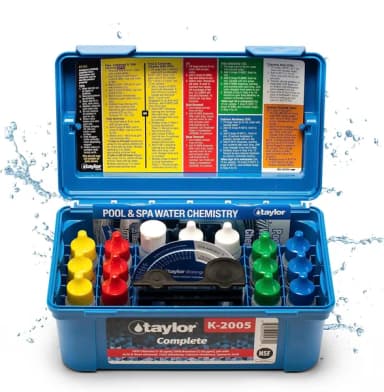
The cheapest kit we track that reads CYA by drop test rather than a colour band. It also reads calcium hardness, which is the other slow-moving number worth knowing before you replace a large volume of water.
Doing it
How to actually replace the water
Check the water table first, and take this seriously. An empty or near-empty pool is a large buoyant shell in wet ground. Vinyl and fibreglass pools can float out of position, and a fibreglass shell that has lifted is a five-figure problem. If you have a high water table, recent heavy rain, or any doubt at all, drain in stages and never below the level your builder specifies.
Drain and refill in stages rather than all at once. Take out a third, refill, let it circulate for a few hours, then repeat. It is slower than one big drain but it keeps the shell loaded, keeps some sanitiser in the water throughout, and lets you re-test between stages instead of overshooting. Staged dilution reaches the same endpoint — the maths does not care whether you did it in one pass or three.
Do not drain through the skimmer or the main drain unless you know your plumbing. Most people are better served by a submersible pump and a hose to a legal discharge point. Check your local rules before you send several thousand gallons of chlorinated water into a storm drain — many jurisdictions have something to say about it, and some require the chlorine to be neutralised first.
Re-test everything afterwards, not just CYA. Fresh fill water brings its own chemistry: calcium hardness, alkalinity and pH will all have moved, sometimes a long way, and if you are on a well the fill can carry iron or copper that stains. You will also have diluted your salt if you run a cell. Budget for rebalancing as part of the job rather than a surprise afterwards.
Where this leaves you
Don't drain thousands of gallons on the strength of a strip
- Reads CYA by drop test — the number this entire page depends on
- One buyer's strips missed a CYA level over 220 ppm while reporting everything fine
- Also reads calcium hardness, which fresh fill water will move
- Cheaper than the water you would waste getting the decision wrong
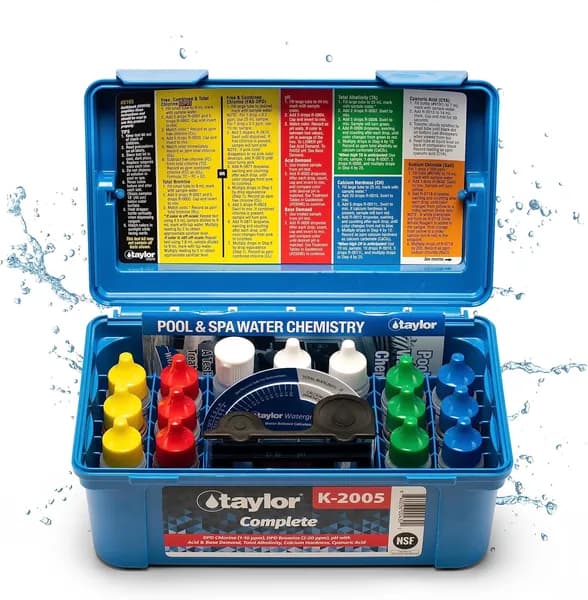
We have not tested this kit. It is the cheapest we track that reads CYA by drops rather than a colour band.
The questions the forum threads keep re-asking