Chemistry · Updated 18 August 2026
Free chlorine vs total chlorine
One of these numbers tells you whether your pool is sanitised. The other tells you whether to believe it. The gap between them is the reading that matters.
What your two chlorine readings mean
Free, total and the gap between them — read against your stabiliser level, not against a fixed 3 ppm.
Combined chlorine is 0.8 ppm, above the 0.5 ppm action threshold. That is chloramine — chlorine that has reacted with sweat, urine, sunscreen and skin and is now spent. It is also what people are smelling when they say a pool smells of chlorine, and what stings eyes. The smell is a symptom of too little free chlorine, not too much.
Clearing it means pushing free chlorine past the breakpoint, to 16 ppm for this pool — a rise of 14 ppm from where you are. That target accounts for your CYA of 40 as well as the combined figure, because the two set different floors and the higher one wins.
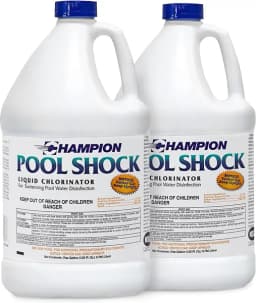
Champion / CPDI Liquid Chlorine 12.5%, 1 Gal 2-Pack
A breakpoint dose is several times a routine correction, which is exactly when the by-product starts to matter. This is the only common form that leaves neither calcium hardness nor cyanuric acid behind.
$36.99 · 4.6★ · 1,542 reviews
The short version
Free chlorine is what is left to work with
Free chlorine is the chlorine in your water that has not yet reacted with anything. It is the only part that can kill bacteria or algae, so it is the only part that means your pool is safe to swim in.
Combined chlorine is what free chlorine turns into once it does its job. Swimmers bring nitrogen compounds into a pool — sweat, urine, sunscreen, skin, cosmetics — and chlorine reacts with them to form chloramines. Chloramine is spent chlorine. It cannot sanitise anything, it is what smells, and it is what makes eyes sting.
Total chlorine is simply the two added together. It is not a third substance and it is not a measure of quality; it is an arithmetic total that a test can read directly. Free plus combined equals total, which means combined is total minus free — a subtraction, not a measurement.
That subtraction is the whole reason both readings exist. A single chlorine number tells you how much chlorine has been in your water. Two numbers tell you how much of it is still able to do something, and the difference is a running score of how well your chlorine has been keeping up with what the pool is throwing at it.
The failure this page exists for
A pool can read three parts per million and be unsanitised
Here is the situation that makes this more than a vocabulary lesson. Two pools are tested with a strip that has one chlorine pad. Both come back at 3 ppm. The owners both put the strip in the bin and go and do something else.
In the first pool, that 3 ppm is all free chlorine. The water is properly sanitised. In the second, free chlorine is 0.4 and combined is 2.6 — the chlorine has been overwhelmed, almost everything it had has been converted to chloramine, and there is effectively nothing left protecting the water. That pool is days away from going green. It reads exactly the same as the healthy one, and it will keep reading 3 the entire way down.
This is not an edge case. It is the standard path a neglected pool takes, and the single-number test that misses it is by far the most widely used test in the country. The second pool’s owner is not careless — they tested, they got a normal number, and their equipment could not tell them the number was made of the wrong thing.
The direction of the error is what makes it dangerous. A test that under-reads makes people add chlorine they may not need, which is wasteful. A test that reports spent chlorine as if it were working chlorine reassures people at exactly the moment they should be worried.
Worked example
The reading that looks fine and isn't
A pool at the end of a hot week with several guests over. The owner tests with a DPD kit: free chlorine 0.4 ppm, total chlorine 3.0 ppm. Cyanuric acid is 40.
- 1Total chlorineWhat a single-pad strip would have reported, and it looks normal3.0 ppm
- 2Free chlorineThe part that can still sanitise0.4 ppm
- 3Combined chlorineTotal minus free — over five times the 0.5 action threshold2.6 ppm
- 4Share still workingAlmost all of the reading is spent chlorine13%
- 5Target for CYA 40What free chlorine should be holding at this stabiliser level4.6 ppm
- 6Breakpoint level for that CCWhere free chlorine has to go to destroy the chloramine26.0 ppm
The gap between line one and line two is the entire diagnosis, and no single-number test can produce it. Note the last two lines especially: this pool does not need a top-up to 4.6 ppm, it needs a shock to 26. Dosing to the routine target would consume itself against the chloramine already in the water and leave the reader back where they started, which is exactly what “I keep adding chlorine and it disappears” means.
It is worth sitting with the 13% figure. Nearly nine tenths of the chlorine this owner has paid for, added and measured is doing nothing at all — and the only instrument that reveals it is a second reading.
The second failure, which nobody writes about
Clean combined chlorine does not mean enough free chlorine
Everything above is the well-covered half of this topic. There is a second way the same pair of numbers goes wrong, and it is quieter, because on this one both readings look respectable.
Suppose free chlorine reads 3.0 and total reads 3.1 — the number nearly every bottle and every strip colour chart treats as correct. Combined chlorine is 0.1: excellent, well under the threshold, nothing to break. By the logic of every free-versus-total explainer, this pool is fine.
It is fine at CYA 30. At CYA 80 it is under-sanitised, and it has been for a while. Cyanuric acid binds chlorine and holds it in reserve, protecting it from sunlight but also keeping most of it inactive at any given moment. The consequence is that the free chlorine number you need is not fixed — it scales with your stabiliser level. A pool at CYA 30 wants around 3.5 ppm. The same pool at CYA 80 wants around 9.2 ppm for the same sanitising power.
So 3.0 ppm free chlorine is comfortably adequate in one pool and almost exactly a third of what is needed in another, and the reading that decides which is which is the one on the CYA test. This is why the calculator at the top of this page asks for cyanuric acid before it will tell you what your chlorine numbers mean. An explanation of free versus total that stops at the subtraction cannot catch this, and most of them stop there.
Google itself surfaces the symptom as a question on this exact search: why is total chlorine ok but free chlorine is low? Both answers appear on this page, because there are genuinely two different causes and they need opposite responses. If combined chlorine is high, you have a chloramine problem and the answer is breakpoint chlorination. If combined chlorine is clean and free chlorine is still under target, you do not have a chloramine problem at all — you have a stabiliser level that has quietly raised the bar.
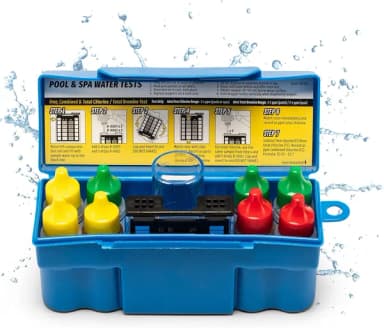
Taylor K-1004 DPD 6-in-1
DPD drops for free and total chlorine as two separate tests, plus pH, alkalinity and acid demand. It does not read cyanuric acid — if you already have that number from strips, this is the missing half.
$27.99 · 2,358 reviews
Why the equipment decides
Not every drop kit gives you free chlorine either
The usual advice is “strips are bad, get a drop kit”. That is too coarse, and it leaves people confident about a kit that has the same blind spot.
The classic yellow test is OTO — the one where a few drops turn the sample from pale straw to deep amber. It is cheap, it keeps well, and it is the kit a great many pool owners inherited with the house. It measures total chlorine. It does not measure free chlorine and cannot be made to, so it has exactly the same limitation as a one-pad strip while feeling considerably more scientific.
DPD is the method that separates them, and it does so in two steps rather than one test. The first reagent reacts only with free chlorine and gives a pink colour; you read that. A second reagent then releases the combined fraction as well, the pink deepens, and you read again. The first number is free, the second is total, and the difference is combined. That two-step structure is the reason a DPD kit can answer this page’s question and a single-pad test never can — it is not a matter of accuracy or price, but of how many measurements the method takes.
There is a refinement worth knowing about if you intend to act on small differences. Colour-matching DPD against a comparator block is a judgement call, and the 0.5 ppm action threshold is a small gap between two similar pinks. FAS-DPD is a titration instead of a colour match: you add a reagent drop by drop until the pink disappears and count the drops, which turns a subjective comparison into a count and resolves far finer. Which Taylor model does which is a genuine fork in the range rather than a marketing tier.
A note on strips in fairness to them: some do carry both a free and a total pad, and those can in principle produce a difference. The practical problem is resolution rather than principle. You are asked to distinguish two similar shades and then subtract one from the other, and the number you want out of that subtraction is often smaller than the error in either reading. For a fast daily check that chlorine is present and pH has not run away, strips remain the sensible tool — this one specific number is where they stop being one.
Where the threshold comes from
Why 0.5 ppm, and why zero is not the target
The number almost universally used as the action point for combined chlorine is 0.5 ppm. It is worth understanding what kind of number that is, because it is not a safety cliff.
Some combined chlorine is unavoidable and is a sign of a working pool. Chlorine reacting with what swimmers bring in is chlorine doing its job; the reaction product has to exist for a moment before it is destroyed. In a pool holding an adequate free chlorine level, chloramines are broken down continuously and never accumulate to anything much. So a small reading is normal turnover, not a fault, and chasing zero is chasing an artefact.
What 0.5 marks is the point where accumulation is outrunning destruction. Above it, the chloramine is building faster than your free chlorine is clearing it, and that is a trend rather than a state — left alone it continues, and the free chlorine number falls as more of it is converted. Acting there rather than at 2 ppm is what stops the spiral in the worked example above.
There is a measurement reason to be relaxed about small readings too. Combined chlorine is a difference between two imperfect readings, so its errors add. If each of your readings is good to a couple of tenths, a computed 0.2 ppm of combined chlorine may be nothing at all. On a colour-matching kit, treat small non-zero results as “probably nothing”, and pay attention to the trend across several tests rather than to any single value.
When the reading is genuinely above the threshold, the response is not more routine dosing. Breakpoint chlorination means driving free chlorine high enough that the nitrogen is oxidised away entirely rather than converted into yet more chloramine, and the level required is set by how much combined chlorine you have and by your CYA — whichever demands more.
Doing the test properly
Four things that quietly ruin a chlorine reading
Sample from the right place. Elbow-deep, away from the returns and away from the skimmer, on the opposite side of the pool from where anything was last added. A sample taken from the surface next to a return is measuring the last thing you poured in, not your pool.
Give the second reading its full time. The total-chlorine step needs the reagent to finish developing. Read it early and the colour is too pale, which makes total look lower than free — an impossible result, and by far the most common reason people see one. If your total ever comes out below your free, that is a failed test rather than a strange pool.
Know what a zero means straight after a big dose. Very high free chlorine bleaches DPD reagent, so a sample can flash pink and then go clear, reading as zero. Immediately after shocking, a zero almost always means the opposite of what it looks like. Dilute the sample with distilled water, re-test, and multiply back — do not add more chemical.
Check your reagent dates. DPD reagents degrade, faster in heat and light, and an old bottle under-reads. That failure is not obvious because it does not produce a nonsense number — it produces a plausible one that is quietly too low, and it drifts as the season goes on. Reagents are sold individually for exactly this reason, so an expired bottle does not mean a new kit.
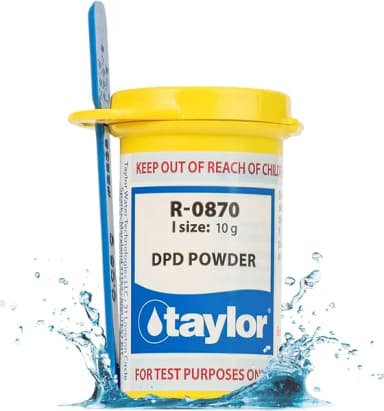
Taylor R-0870 DPD Powder, 10 g
R-0870 DPD powder, 10 g. If your kit has stopped developing a convincing pink, this is usually the bottle at fault rather than the kit.
$10.49 · 1,207 reviews
What this method can’t tell you
The limits of a free and total chlorine reading
Combined chlorine tells you that chloramines are present. It does not tell you which ones, and that distinction occasionally matters — monochloramine, dichloramine and nitrogen trichloride form under different conditions and differ in how irritating they are. A residential test cannot separate them. If a pool has a strong smell at a low combined reading, that is a case for a forum with people who will ask about your specific circumstances, and TroubleFreePool is where we would send you.
Neither reading says anything about pH, and pH strongly affects how much of your free chlorine is in its active form — the same 4 ppm does noticeably less work in alkaline water. The levels chart shows where every reading belongs and which ones interact. And a chlorine test says nothing at all about whether your filter is running long enough to circulate what you have added.
Where this leaves you
Combined chlorine needs two readings, so it needs a two-step test
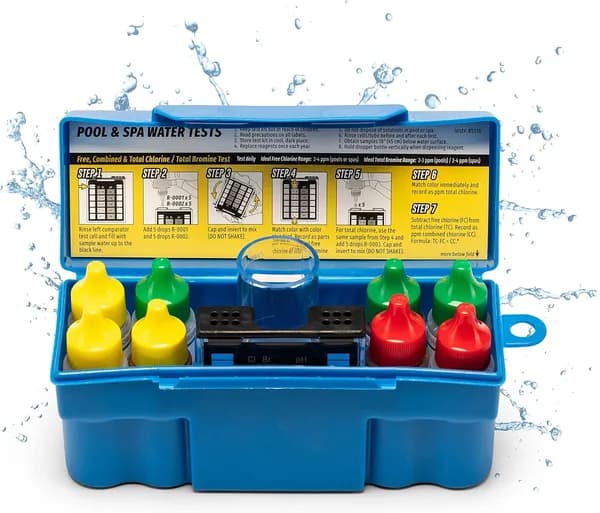
- Runs free chlorine and total chlorine as separate DPD tests — the difference is combined chlorine
- Also reads pH, total alkalinity and acid demand, so one kit covers the routine balance checks
- Reagents are sold individually, so the bottle that expires first isn't a new kit
- Cheapest kit we track that separates the two chlorine readings at all
It does not read cyanuric acid, and this page's calculator needs that number — if you don't already have it from strips or a pool store, the decider on our test-kit page will point you at a kit that reads both instead.
Follow-ups