Chemistry · Updated 18 August 2026
Pool opening checklist
Every opening checklist gives the order. This one gives the amounts — for your pool, from your opening test — and says which steps you can skip, including, quite often, the shock.
Pool opening calculator
Your opening test in, the whole startup sequence out — in order, with an amount for every step.
- 1Total alkalinityBaking soda, 60 → 80 ppm. First, because it moves pH too — to about 7.50 on its own. Broadcast over the deep end, pump running.5 lb 6.1 oz
- 2pH7.50 after step 1 — in range. Nothing to add.—
- 3Calcium hardnessCalcium chloride, 200 → 300 ppm. That figure is for 94% pellets; 77% flake needs 23 lb 1.3 oz. Read your label. Dissolve in a bucket of pool water first — it gets hot.18 lb 14.5 oz
- 4Stabiliser (CYA)20 → 30 ppm. In a skimmer sock or a bucket, never straight onto the floor; it takes days to dissolve, so do not re-dose on a low reading. It is an acid: once dissolved, expect pH near 7.32.1 lb 9.6 oz
- 5Chlorine: a routine dose — no shock neededLiquid chlorine to 3.5 ppm, worked out from CYA 30 — the level after step 4, not today's. Clear water and no combined chlorine: a shock dose would buy nothing. Test again at dawn — if it has lost more than about 1 ppm overnight, something is eating it, and that is when to shock. Last, at dusk, pump running.68.8 fl oz
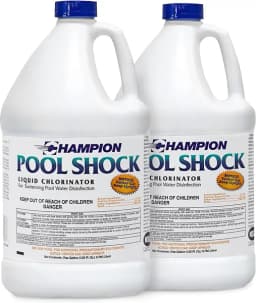
Champion / CPDI Liquid Chlorine 12.5%, 1 Gal 2-Pack
Stated 12.5% — the strength this dose is calculated for. It adds no stabiliser and no calcium, so it cannot undo steps 3 and 4. 19,200 gallons needs 68.8 fl oz.
$36.99 · 4.6★ · 1,542 reviews
The short version
Six chemicals, one order, and each step changes the next
The order is not in dispute. Every opening guide worth reading agrees on it: alkalinity, then pH, then calcium, then stabiliser, then chlorine, with salt slotted in before the cell goes on in a salt pool. What those guides almost never say is how much, and they rarely explain why the order is the order — which is the part that tells you what to do when your pool does not match the example.
The reason is that the steps are not independent. Baking soda raises pH as well as alkalinity, so pH cannot be judged until alkalinity is settled. Calcium added to high-pH water comes straight back out of solution as a milky haze, so pH has to be in range before calcium goes in. Stabiliser sets the chlorine target — the same free chlorine reading is plenty at CYA 30 and not enough at CYA 70 — so it has to be decided before you can know how much chlorine to add. And stabiliser is itself an acid, so it pulls pH back down after you have set it. That last one is the step that surprises people, and it has its own section below.
The other thing the calculator does that a printed checklist cannot is leave things out. Most pools do not need all six. A pool that closed well often opens needing only chlorine and a little baking soda. Buying an opening kit means buying the average pool’s shopping list, and your pool is not the average one.
Before any chemical goes in
The mechanical checklist
Chemistry comes last for a reason: everything before it changes the water you would be dosing. Fresh water dilutes it, debris consumes chlorine, and still water gives a false reading. Do these first, in this order.
- 1Get the water off the cover, then take the cover off.Pump or siphon standing water and sweep off the leaves first. Pulling a full cover drags a winter of debris and stagnant water into the pool, and every bit of it becomes chlorine demand. Clean and dry the cover before you store it or it will be mouldy next autumn.
- 2Take out the winter hardware.Skimmer ice compensators, return-line plugs, and any winterising plugs in the lines. Put the drain plugs back into the pump, filter, heater and any in-line chlorinator — they were removed so water could not freeze in them, and a missing one is the commonest opening-day leak.
- 3Put the pool back together.Ladders, rails, steps and diving board. Check the bolts and bumpers while they are out of the water rather than after someone has climbed on them.
- 4Bring the water up to the middle of the skimmer opening.Too low and the skimmer draws air and the pump loses prime; too high and the skimmer stops skimming. Note roughly how much you added — fresh water dilutes every reading, which is exactly why you test after this step, not before.
- 5Start the pump and look for leaks.Prime it, open the valves, and watch every union and the filter lid for drips for the first few minutes. Clean or rinse a cartridge; a sand filter does not need a backwash just because it is spring.
- 6Get the debris out before any chemistry goes in.Skim, brush the walls and floor, and vacuum. Chlorine spent oxidising leaves you could have lifted out with a net is money in the skimmer basket.
- 7Circulate for a day, then test everything.Water that has sat still all winter is layered. A test taken the moment the pump starts reads the top of the pool, not the pool. Run a full test — pH, alkalinity, calcium, CYA, free and total chlorine, and salt for a salt pool — and put the numbers into the calculator.
Steps 1 and 2
Alkalinity before pH, because one product moves both
Alkalinity is the buffer that holds pH in place, and winter usually leaves it low: rain and snowmelt are soft and slightly acidic, and a pool topped up with fresh water dilutes whatever buffer it had. Baking soda raises it. It also nudges pH up on the way in, and that nudge is often all the pH correction a pool needs. In the default pool in the calculator, taking alkalinity from 60 to 80 ppm carries pH from 7.4 to about 7.5 without a single ounce of pH increaser.
That is why pH is step two and not step one. Adjust pH first and then add baking soda, and you have moved pH twice. The calculator runs the pH step on the water after the baking soda, and it inherits two refusals from the raise pH and alkalinity calculator. It will not add soda ash when doing so would push alkalinity over its ceiling — low pH with healthy alkalinity is a pool holding excess CO₂, and aeration fixes it for free. And it will not add anything to raise alkalinity when pH is already high, because both products push pH higher still.
We do not compute an acid dose, here or anywhere on this site. If your opening pH is above 7.8, bring it down with small measured amounts of acid and re-test before calcium or chlorine. Pool acids are often sold without their strength stated, and a dose built on a guessed strength is not safe to publish.
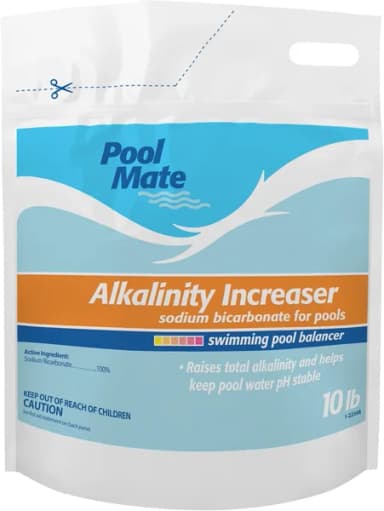
Pool Mate Alkalinity Increaser, 10 lb
Stated on the listing as 100% sodium bicarbonate, with a printed dose that agrees with this calculator to within 2%. It is the same chemical as grocery-store baking soda — buy whichever is cheaper per pound where you are.
$17.61 · 1,282 reviews
Step 3
Calcium: the step your surface decides
Calcium hardness matters in proportion to how much calcium your pool is made of. Plaster, pebble finishes and tile grout are calcium compounds, and water short of calcium dissolves it out of them — slowly, invisibly and permanently. So a plaster pool wants 250–450 ppm and the calculator raises a low one to 300. Vinyl and fibreglass have nothing to give up, and the calculator only acts below 150.
The product is calcium chloride, and it is sold in two forms that dose differently. Pellets are about 94% calcium chloride; flake is about 77%, the rest being bound water. For the same rise, flake needs about a fifth more. Worked from the molar masses, 10 ppm in 10,000 gallons takes 15.8 oz of 94% pellets or 1 lb 3.2 oz of 77% flake — and calcium increaser labels print 1.2 lb for flake, which matches. The calculator shows both. Read your label for which one you have.
Two cautions. Calcium chloride gets hot as it dissolves, so dissolve it in a bucket of pool water — chemical into water, never the other way round — and pour it in around the edges with the pump running. And calcium is the one reading on this list that only comes down with fresh water, so undershoot and re-test rather than overshoot. If your fill water is hard, as it is across much of the Southwest and the Midwest, the reading after a top-up may already be enough. We have not verified a specific calcium product, so this step carries no recommendation.
Step 4 — the one that surprises people
Stabiliser pulls your pH back down
Cyanuric acid is, as the name says, an acid. It does not change your alkalinity reading — each unit that dissolves adds a unit that counts toward alkalinity and uses up a unit that did, so the total holds — but it shares the same alkalinity across more buffer, and pH falls. Worked through the carbonate chemistry, from a starting pH of 7.5:
| Stabiliser added | Alkalinity | pH once dissolved |
|---|---|---|
| Topping up, CYA 20 → 30 | 80 ppm | 7.32 |
| Fresh fill, CYA 0 → 30 | 80 ppm | 7.08 |
| Fresh fill, CYA 0 → 30 | 100 ppm | 7.13 |
| Fresh fill, CYA 0 → 50 | 80 ppm | 6.95 |
| Salt pool fresh fill, CYA 0 → 70 | 70 ppm | 6.83 |
A top-up of 10 ppm is a small dip. A freshly filled or heavily drained pool taking its whole season’s stabiliser in one go can land under 7.2 — and a salt pool going from zero to 70 drops the most of all. This is one reason the pool that was “perfect” on opening day reads low on pH four days later, and it is not a test error.
The calculator shows the post-stabiliser pH in its third tile. What it does not do is dose soda ash for the dip in advance, for two reasons. Stabiliser takes days to dissolve fully, so the drop arrives slowly. And pool water is almost always losing CO₂ to the air, which pushes pH back up at the same time — these figures are the drop before any of that recovery, so they are the floor, not the forecast. Re-test pH three or four days after the stabiliser goes in and correct then, from the reading you actually have.
As for how much: the calculator raises a chlorine pool to 30 ppm and a salt pool to 70, the bottom of each range, and only when the pool is at least 10 short — CYA tests read in coarse steps and a smaller gap is inside the error. Aim low because stabiliser never leaves except with water: every trichlor tablet you use this summer adds more. How many tablets your pool needs works out how much. Put granules in a skimmer sock or a bucket rather than on the floor, and do not re-dose because a reading two days later looks low; it has not finished dissolving.
The last step
Shock or chlorine? Usually just chlorine
“Shock the pool” appears on every opening checklist, and every opening kit includes a bag of it. But shock is not a different chemical. It is a higher level of the same one, and it does two specific jobs: killing algae, and burning off chloramines — combined chlorine, the difference between a total and a free chlorine reading. A pool that opens clear, with combined chlorine under 0.5 ppm, has neither problem. It needs free chlorine brought up to its routine target, which at CYA 30 is 3.5 ppm. The shock level at the same CYA is 12 ppm: three and a half times the chlorine, for nothing.
So the calculator only shocks when there is something to shock. Green water, or cloudy water whose free chlorine is under the minimum for its stabiliser, is treated as algae and gets the shock level, with a link to the plan for holding it. Clear water with combined chlorine at 0.5 or more gets the same breakpoint logic the pool shock calculator uses. Everything else gets a routine dose. If your kit cannot split free from total chlorine, put 0 in the combined field and use the overnight test instead: dose at dusk, test again at dawn, and a loss of more than about 1 ppm means something is consuming it. That is the signal to shock, and it costs nothing to find out.
The form of chlorine matters at opening more than any other time, because you have just set calcium and stabiliser deliberately. The calculator doses liquid chlorine because it leaves neither behind. A shock dose of cal-hypo — about 2 lb 15 oz to reach 12 ppm in 19,200 gallons — adds 8.4 ppm of calcium on top of step 3. The same shock with dichlor adds 10.8 ppm of stabiliser on top of step 4, and that one never comes out. Add chlorine last, at dusk, with the pump running: at opening the stabiliser has not dissolved yet, and sunlight destroys unstabilised chlorine in an afternoon.
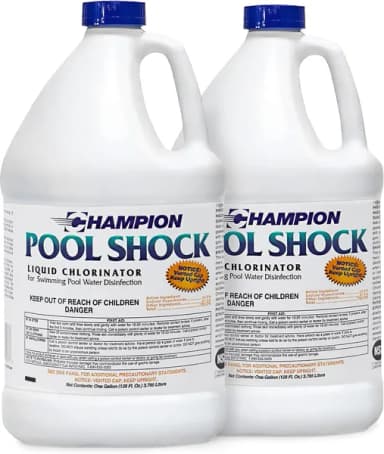
Champion / CPDI Liquid Chlorine 12.5%, 1 Gal 2-Pack
Stated 12.5%, the strength every chlorine amount on this page is calculated for. It adds no stabiliser and no calcium, so it cannot undo the two steps before it. At a routine opening dose, one 2-pack covers a typical pool with plenty to spare.
$36.99 · 1,542 reviews
Worked example
A 19,200 gallon plaster pool, opening clear
16 × 32 ft, 5 ft average depth. The cover came off clean. After a day of circulation the test reads pH 7.4, alkalinity 60, calcium 200, CYA 20, free chlorine 0 and combined chlorine 0.
- 11 · Baking soda, alkalinity 60 → 80pH rises to about 7.5 on its own as a result5 lb 6.1 oz
- 22 · Soda ashpH is already in range after step 1none
- 33 · Calcium chloride, 200 → 300 (94% pellets)23 lb 1.3 oz if the bag is 77% flake18 lb 14.5 oz
- 44 · Stabiliser, CYA 20 → 30pH settles to about 7.32 once it has dissolved — still in range1 lb 9.6 oz
- 55 · Liquid chlorine to 3.5 ppmRoutine target for CYA 30 — the level after step 4, not the 20 it reads today68.8 fl oz
Salt pools only — just before the chlorine
Salt: test before you buy the bags
Salt is the reading people most often overbuy for, because the charts start from zero and almost no pool does. Salt does not evaporate and the cell does not use it up; it leaves only with water, through splash-out, backwashing and whatever was drained to winterise. So a pool that closed in range usually needs a top-up, not a fill.
The arithmetic is simple and checkable: a pound of salt in 10,000 gallons adds 12 ppm. From zero, 20,000 gallons needs 534 lb to reach 3,200 ppm — Hayward’s published chart says 533, so the derived figure and the manufacturer’s agree to within a pound. From an opening reading of 2,400, the same pool needs 134 lb. That is four 40 lb bags rather than fourteen.
Check your own cell’s target before you add anything — they vary by model, and the calculator doses to 3,200 because that is the most common figure. Add salt before the cell goes on, brush it off the floor so it does not sit on the plaster, and circulate for a day to mix it before switching the cell on. Salt can only be lowered by replacing water, so the same rule as calcium applies: under is fixable in an afternoon, over is not. Chlorine for the opening dose still comes from a bottle, not the cell: a cell is sized to replace a day’s losses, not to lift a pool from zero, and it should not be switched on until the salt has mixed anyway.
When is it open?
The finish line is a test, not a date
An opening is finished when three things are true together: the water is clear, the readings are in range, and free chlorine holds overnight — tested at dusk and again at dawn, losing no more than about 1 ppm. That last test is the one that tells you whether the winter left anything behind that is still consuming chlorine. Until it passes, keep the pump running continuously and keep the chlorine up.
If the water came out from under the cover green, the opening is really a clear-up, and the calculator switches to shock level and says so. How to clear a green pool works out how many days that takes and how much chlorine the whole job needs, which is the number to know before deciding whether some of the water is worth replacing instead. If the water is cloudy but the chlorine is healthy, it is usually filtration rather than chemistry — why is my pool cloudy works out how long your pump and filter need.
After that, the pool is a maintenance pool. The pool chemical levels chart has every target in one place, and how much chlorine to add covers the routine dose from here.
What this page cannot tell you
The limits, stated plainly
We have not opened your pool, or anyone’s, and make no claim to have tested these products in water. The doses come from the molar masses of the chemicals and the published chemistry of carbonate buffering, and we check them against what manufacturers print: the salt figure agrees with Hayward’s chart to within a pound, the calcium figure with printed label doses, and the baking soda figure with a manufacturer label to within 2%. Where a manufacturer and the model disagree, the raise-pH page records it rather than quietly tuning the model to match.
Every pH figure is the reading immediately after a chemical dissolves, before the pool has exchanged CO₂ with the air, so real pH usually ends up a little higher. The calculator does not model borates, water temperature, or phosphates, and it cannot tell whether your test is right — which, at opening, is the reading that matters most, because every dose on this page scales with it. It also cannot see equipment: a cracked winterised line, a failing pump seal, or a heater that needs servicing before it is fired is a job for a pool professional, not a calculator. For readings that refuse to behave the way these numbers say they should, the TroubleFreePool forum will work through them with you.
Questions
Opening a pool, answered with the numbers
Where this leaves you
The opening test is the one test a year that sets every dose
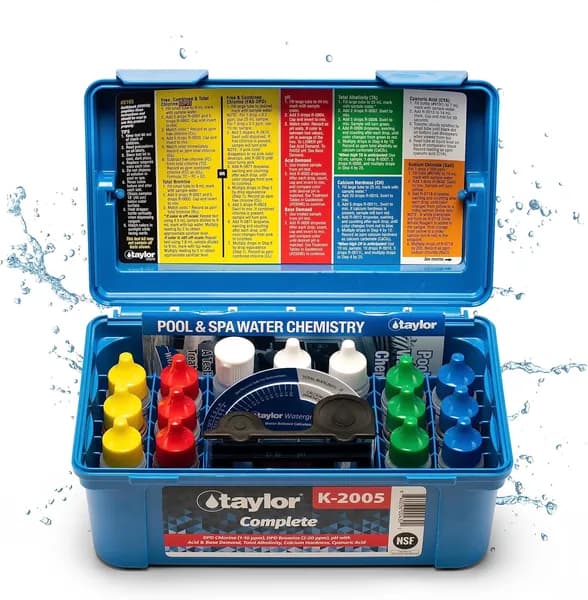
- Reads calcium hardness and cyanuric acid — the two opening readings most strips and basic kits skip.
- Splits free from total chlorine, which is what decides whether you need shock at all.
- Titrates alkalinity in 10 ppm drops, the resolution the baking soda dose is built on.
- Reads every input this calculator asks for except salt. The K-1005 reads the same set with smaller bottles that run out sooner.
It is the expensive option, and this is the page where it earns it: opening is a full test, once. For routine testing through the summer, $11.99 strips cover pH, chlorine, alkalinity and CYA. Salt pools need a separate salt test or the cell's own reading.
Working on a different part of the same problem? Free vs total chlorine explains the combined-chlorine reading this page asks for, lowering cyanuric acid covers a pool that opens over range, and which test kit reads what compares the kits.