Chemistry · Updated 18 August 2026
Why is my pool cloudy?
There are two completely different reasons, the fix for one does nothing for the other, and the more common one costs nothing at all.
Why is your pool cloudy?
Your readings and your filter, together — including how long this can possibly take.
Typically rated 20–40 microns. Cloudiness is caused by particles under 5.
Your chemistry is fine and your pump is moving enough water — 1 turnover a day. The limit is what your filter can hold on to. A sand filter is typically rated to 20–40 microns, and the particles making water look cloudy are under 5. It catches them slowly, by chance rather than by design, which is why this pool clears in days rather than hours. Rated four to eight times coarser than the particles making the water cloudy. A sand bed filters best when it is slightly dirty, because the trapped debris is what narrows the gaps — so backwashing daily during a clear-up resets the only thing helping you. Keep filtering and expect 7.5–15 days at your current runtime; running longer is the one lever that shortens it.
The short version
Cloudy water is one symptom of two unrelated problems
Every guide on this subject gives you the same list: shock it, run the pump, add clarifier, check your chemistry. The list is not wrong. It is just not an answer, because it does not tell you which of those four is your problem, and they range in cost from nothing to a hundred dollars.
The useful split is much simpler than a four-item list. Either your water contains something it should not — the beginning of an algae bloom, a load of spent chloramine, calcium coming out of solution — or your water is fine and your filter has not yet removed what is suspended in it. The first is chemistry and you fix it with a product. The second is a rate problem and you usually fix it by changing a timer.
Those two failures produce visually identical water. You cannot tell them apart by looking, which is exactly why so many people work through the list from the wrong end — buying a clarifier for a pool whose real problem is that the pump runs six hours a day, or running the filter for a fortnight on a pool that is quietly growing algae. The calculator above asks for both halves at once because the answer genuinely requires both.
The part nobody computes
Filtration is exponential, so “one turnover a day” is not what it sounds like
A pool filter does not work through your water like a queue, cleaning each gallon once and setting it aside. Filtered water goes straight back into the pool and mixes with the dirty water immediately. So the filter is never processing dirty water; it is processing a steadily improving mixture, and every pass removes a share of what remains rather than a fixed amount.
That single fact changes the arithmetic completely, and it is why clearing a pool always takes longer at the end than it did at the start. Treating the pool as well mixed, the fraction of suspended material still in the water after a number of turnovers falls away exponentially. For a filter that captured everything on every single pass:
| Turnovers | Removed | Still suspended |
|---|---|---|
| 1 | 63.2% | 36.8% |
| 2 | 86.5% | 13.5% |
| 3 | 95.0% | 5.0% |
| 4 | 98.2% | 1.8% |
Read the last column again, because it is the whole point. The standard advice to run your pump for one turnover a day sounds like the water gets cleaned daily. What it actually means is that roughly a third of this morning’s cloudiness is still there tonight — and that is the best case, achieved only by a filter that misses nothing. Three turnovers gets you to 95%, which is where water starts looking clear rather than merely better.
This gives you something no other page on this question will: a hard floor. Your pool volume divided by your pump’s flow rate gives one turnover in hours, and three of those is the fastest any filter could possibly clear your water. The calculator above reports that number separately from its estimates, because it is arithmetic rather than a guess — nothing you buy can beat it, and if the floor alone is longer than you have been waiting, your pool is not stalled. It is on schedule.
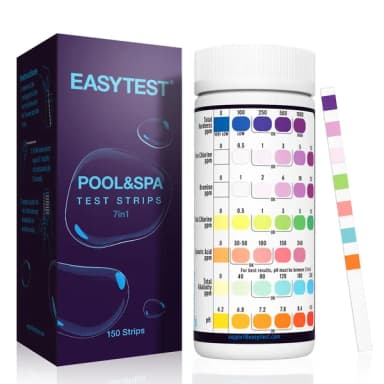
EasyTest 7-Way Pool Test Strips, 150 strips
Cheapest way to get cyanuric acid and calcium hardness, which are the two numbers that decide whether “my chemistry is fine” is actually true. Without CYA you cannot know what your chlorine should be; without hardness you cannot rule out calcium.
$11.99 · 20,264 reviews
The other half of the problem
Your filter is rated coarser than the particles making the water cloudy
Turnover tells you how fast water reaches the filter. It says nothing about whether the filter can hold what arrives, and that is the second failure — the one that produces the genuinely maddening case where the pump has run continuously for a week and the water is still not right.
Cloudiness is a light-scattering problem. Anything big enough to see on its own settles out or gets caught on the first pass; what stays suspended and turns water milky is fine material, broadly under five microns and often nearer one. Dead algae after a shock, calcium precipitate, pollen and fine dust all sit in that range. Now compare that with what the three common filter media are typically rated to hold:
| Medium | Rated to | Turnovers to clear | Against 5 micron particles |
|---|---|---|---|
| Sand | 20–40 µm | 7.5–15.0 | |
| Cartridge | 10–20 µm | 4.3–7.5 | |
| DE | 3–5 µm | 3.2–3.7 |
A sand filter is rated four to eight times coarser than the particles causing your problem. It still catches them, but slowly and by chance rather than by design — fines bridge across gaps and lodge in the bed — which is why the same pool that a DE filter clears in about a day can take a sand filter several. Nothing is broken in that pool. It is doing exactly what a sand filter does.
There is a genuinely counterintuitive consequence, and it is the single most useful thing on this page for sand-filter owners: a sand bed filters better when it is slightly dirty. The trapped debris is what narrows the gaps between grains. Backwashing every day during a clear-up therefore resets the only thing working in your favour, and people do it precisely because they can see the pressure rising and assume that is a fault. Backwash when the pressure has genuinely climbed 8–10 psi over its clean reading, not daily out of diligence.
The turnover figures in that table are the honest kind of estimate rather than a measurement. Nobody publishes a validated single-pass capture rate for residential filters against one-micron particles, so those columns come from comparing the published micron ratings with the particle size — a planning tool for deciding whether to wait or to act, superseded the moment you can see your own water changing.
Worked example
Two pools, identical in every way except a timer
19,200 gallons, 40 GPM pump, sand filter, chemistry checked and correct: free chlorine 3.0, total 3.1, CYA 40, pH 7.5, hardness 250. One owner runs the pump 6 hours a day; the other runs it continuously.
- 1One full turnover19,200 gallons ÷ (40 GPM × 60) — fixed by the plumbing, same for both8 hrs
- 2Turnovers a day at 6 hoursUnder one — some water does not reach the filter on a given day at all0.8
- 3Turnovers a day running continuouslySame pump, same filter, same pool3.0
- 4Theoretical floor, perfect filterThree turnovers for 95% removal. Nothing can beat this24 hrs
- 5Pump hours needed on sandSand catches these particles slowly, so it needs 7.5–15 turnovers60–120
- 6Clear-up at 6 hours a day10–20 days
- 7Clear-up running continuously2.5–5 days
Ruling out the expensive half first
Three chemistry causes that no amount of filtering will fix
Free chlorine below what your stabiliser demands. This is the one that gets missed, and it gets missed because the reading looks perfectly healthy. The minimum free chlorine a pool needs is not a fixed 3 ppm — it scales with cyanuric acid, because CYA binds most of your chlorine into a reserve and releases it slowly. At CYA 30 the minimum is about 2.3 ppm. At CYA 80 it is 6.0 ppm. So a reader at CYA 80 reading 2.0 ppm has a textbook-clean chlorine test and a pool at a third of its minimum, which is the opening stage of an algae bloom. Cloudy is what a bloom looks like before it looks green. What free and total chlorine actually tell you covers this pair in full, and if it has already turned, clearing a green pool takes over.
A chloramine load. Combined chlorine is the gap between your free and total readings: chlorine that has already reacted with sweat, sunscreen, urine and leaf litter and is now a spent by-product. Above roughly 0.5 ppm it hazes the water and no amount of filtration touches it, because it is dissolved rather than suspended. The fix is breakpoint chlorination — a single large dose, since a partial one produces more chloramine rather than less. The shock calculator works out the target, which is much higher than most packaging implies.
Calcium coming out of solution. Hard water holds calcium only while pH stays low enough. Let pH drift above about 7.8 with hardness above roughly 400 ppm and the water sheds the excess as an extremely fine white precipitate — which is why this kind of cloudiness reads as milky or greyish rather than dull green. Filtering harder does not help, because the pool keeps producing more of it until the pH comes down. Note that this is a risk flag from two readings, not a full saturation index; a proper one also needs alkalinity and water temperature.
We do not calculate an acid dose anywhere on this site, and that is a deliberate limitation rather than an omission. Pool acids are sold at strengths that the listings frequently do not state, and “low-fume” muriatic is roughly half the strength of standard without necessarily saying so on the label. A calculated dose built on a guessed concentration is a genuinely unsafe thing to publish, so the advice here is to add small measured amounts and re-test.
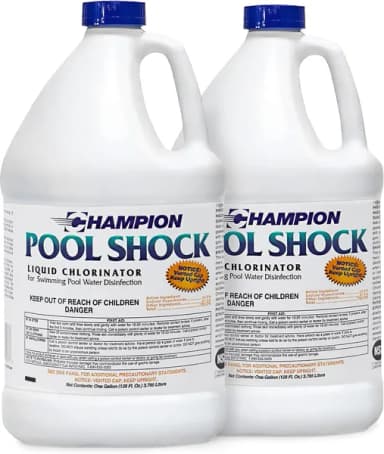
Champion / CPDI Liquid Chlorine 12.5%, 1 Gal 2-Pack
12.5% sodium hypochlorite, the strength our shock target is calculated from. Breakpoint has to arrive as one dose rather than several, and liquid is the form that delivers a large one without adding stabiliser or calcium to water that is already struggling.
$36.99 · 1,542 reviews
The product question, answered honestly
What a clarifier does, and when it is the wrong purchase
“Pool clarifier” is the single most searched follow-up to this question, so it deserves a straight answer rather than a link. A clarifier is a coagulant. It carries a charge that makes fine suspended particles stop repelling each other and clump together, until the clumps are large enough for a filter to catch. It does not dissolve anything, kill anything or remove anything by itself. It makes your existing filter effective against smaller particles than its rating.
Read that description against the four causes above and the answer falls out. It does nothing for a chloramine load, which is dissolved rather than suspended. It does nothing for an algae bloom, which reproduces faster than it can be clumped. It does nothing meaningful for a pool getting under a turnover a day, because water carrying the clumps still is not reaching the filter. It is genuinely useful in exactly one situation: sound chemistry, adequate turnover, and a medium too coarse to hold what is in the water — which in practice means a sand filter that is running plenty and still losing.
That is a real case and it is not rare. But it is the last of four, and it is the only one of the four that most pages on this query ever mention, which is worth knowing when you read them. We do not currently recommend a specific clarifier here, for a simple reason: we have not put one through the product verification the rest of this site’s recommendations go through, and we would rather say so than pick one because the section felt like it needed a link.
Flocculant is a different product and needs a warning attached. It sinks particles to the floor rather than clumping them for the filter, and they then have to be vacuumed directly to waste — not through the filter, or you simply return them to the pool. That requires a multiport valve with a waste setting. Most cartridge-filter systems do not have one, so on those pools flocculant creates a problem with no route out of it.
What this page cannot tell you
The limits, stated plainly
We have not put a test kit in your pool, and this site does not claim to have tested any product in water. Everything above is arithmetic applied to your readings, plus published chemistry and published filter ratings. That leaves real things it cannot see.
It assumes your pool is reasonably well mixed, and a pool with poor circulation — dead corners, a return pointed the wrong way, a partially blocked skimmer — will clear more slowly than any of these figures suggest, because some of its water genuinely is not in the loop. It takes your pump’s flow rate as given, when real flow depends on plumbing resistance and falls as the filter loads, so a nameplate figure is optimistic. It cannot see a torn cartridge, a cracked lateral in a sand bed, or DE grids that need recharging — all of which produce water that never quite clears while every number on this page looks fine. And it cannot tell you whether your test kit is accurate, which matters most for the pH and CYA readings that set everything else.
For any of those, and for a pool that will not clear after a week of doing everything right, the TroubleFreePool forum is where people will look at your actual numbers, in order, and work out which one is lying. A calculator cannot do that and there is no point pretending otherwise.
Questions
Cloudy pool questions, answered with the numbers
Where this leaves you
Every branch of this page turns on a reading a strip may not have given you
- Reads cyanuric acid — the number that decides whether your free chlorine is adequate or a third of what it should be.
- Reads calcium hardness, which is half of the calcium-cloudiness question and absent from most kits.
- Splits free from total chlorine, so you can see a chloramine load rather than infer one.
- Reads pH accurately enough to act on, which is what the calcium branch turns on.
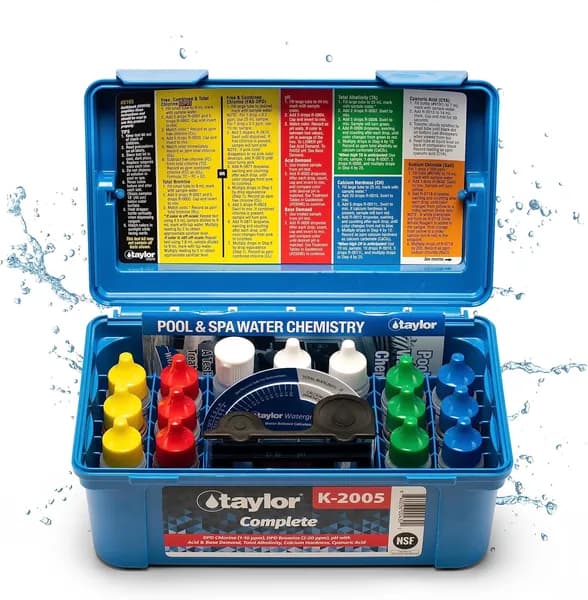
This is the kit for the reader whose strips said everything was fine while the water disagreed — it reads all four inputs this page needs from one sample. If you just want the two readings you are most likely missing, the $11.99 strips above cover CYA and hardness for a sixth of the price, and our test-kit decider sends most routine testers there.
Working on a different part of the same problem? The pool chemical levels chart collects every target on one page, how much chlorine to add handles routine dosing, and which test kit reads what compares the kits themselves.