Chemistry · Updated 18 August 2026
How many chlorine tablets does your pool need?
The rule of thumb is one tab per 10,000 gallons a week. It is wrong about half the time, and here is the number it hides.
How many chlorine tablets does your pool need?
And what that many tablets quietly does to your water.
At 2.5 ppm of chlorine lost per day, a 19,200 gallon pool needs about 6.2 tablets a week. That is the answer to the question you asked.
Here is the answer nobody gives you. Those tablets add 10.5 ppm of cyanuric acid every week — and that figure does not shrink if your pool is bigger, because chlorine demand and CYA are both concentrations. Over 20 weeks that is +210 ppm, taking you from 40 to 250 ppm.
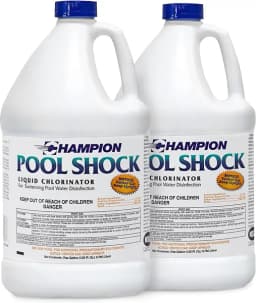
Champion / CPDI Liquid Chlorine 12.5%, 1 Gal 2-Pack
At that ending CYA, tablets alone won't get you through the season. Liquid chlorine adds none at all — most people run tabs while away and liquid the rest of the time.
$36.99 · 4.6★ · 1,542 reviews
The part the rule of thumb hides
Your tablet count is a CYA decision, not just a chlorine one
Every trichlor tablet is about 90% available chlorine and roughly 10% cyanuric acid by effect — it stabilises as it sanitises. That is genuinely useful: stabiliser is what stops sunlight destroying your chlorine within hours. It is also cumulative, permanent, and the reason most American pools drift into trouble.
Here is the piece that surprises people, and the calculator above will show it to you with your own numbers: the CYA your tablets add does not depend on how big your pool is. A bigger pool needs more tablets, but it also has more water to dilute them into, and the two cancel exactly. What drives CYA accumulation is chlorine demand — sun, heat, swimmers — not volume.
So a pool meeting real summer demand on tablets alone gains roughly 10 ppm of CYA every week. That is a pool which is perfectly balanced in June and chlorine-locked by August, with an owner who changed nothing and did everything the bucket told them to.
What to actually do about it
Tablets for maintenance, liquid for everything else
This is not an argument against tablets. They are convenient, they meter themselves, and they are the only practical way to keep a pool sanitised while you are away for a week. The argument is against tablets being your only chlorine.
Liquid chlorine and cal-hypo add no cyanuric acid at all. Most people who stay out of trouble long-term run tabs in the floater as a baseline and correct with liquid — then test CYA monthly rather than discovering it in August. If your CYA is already high, the tablets are also working at a fraction of their strength, so you are burning through them to achieve less.
If your CYA is already past 80, work out how much water you need to replace before you buy another bucket. And if you’re deciding what to dose with instead, the four forms compared covers what each one leaves behind.
Where you put them
🔴 Never put tablets in the skimmer
This is the most common and most expensive tablet mistake, and almost nobody is told about it until after the damage. Trichlor is acidic — a tablet dissolving in a skimmer basket creates a concentrated, low-pH stream that runs straight into your pump, filter and heater.
While the pump is running that stream is diluted immediately and does little harm. The damage happens when the pump shuts off. Undissolved tablet keeps dissolving into the standing water sitting inside your pump housing and heater exchanger, and that water stays there, strongly acidic, for hours. Copper and stainless components corrode from the inside. People replace heaters over this and blame the heater.
Use a floater or an inline chlorinator instead. Both hold the tablets in a stream that only exists while water is moving, which is the entire point. If your pool has no chlorinator and you have been using the skimmer, a $10 floater is the cheapest equipment protection you will ever buy.
Floater or chlorinator
Same tablet, very different control
A floater is a plastic buoy with a dial that exposes more or less of the tablet to water. It is cheap, works on any pool, and is what most above-ground owners use. Its weakness is that it dissolves at whatever rate the water dictates and drifts wherever the current takes it — often into a corner where circulation is poor, which is why floater output is inconsistent week to week.
An inline chlorinator is plumbed into the return line after the filter and heater, and meters a controlled flow of water across the tablets. That gives you an actual dial rather than an approximation, and it keeps the acidic stream downstream of everything expensive. It is the better system by some distance, and on an inground pool it is usually already there.
One practical note that catches people either way: never let a floater sit against a vinyl liner or a fibreglass step. A tablet resting against the surface will bleach and eventually damage it. If your floater keeps parking in the shallow end, tether it.
Why the count changes
Your tablet use isn’t constant, and that’s normal
People notice their floater emptying faster in August than in June and assume something has gone wrong. Usually nothing has. Three things drive it, and only one is a problem.
Water temperature. Tablets dissolve faster in warmer water — the same tablet in 88 °F water disappears noticeably quicker than in 75 °F. That is physics, not a fault, and it happens to coincide with the season when demand is highest anyway.
Flow rate and run time. More water moving past the tablet means faster dissolution. If you increased your pump schedule for summer, your tablet consumption went up with it.
Rising CYA — the one that matters. As stabiliser accumulates, the chlorine your tablets deliver becomes progressively less effective, so you compensate by adding more tablets, which adds more stabiliser. It is a genuine feedback loop, and it is why “I keep needing more tabs” is usually a CYA symptom rather than a demand one. If your consumption has climbed and the weather hasn’t, test CYA before you buy another bucket.
The job tablets genuinely win
Two weeks away
Everything on this page argues for using tablets sparingly, so it is worth being clear about the case where they are unambiguously the right tool: nobody is home. Liquid chlorine needs adding every few days. A salt cell needs power and a working pump. A loaded floater or chlorinator keeps sanitising for a fortnight with nobody touching it, and that is not a small thing.
For a two-week absence, load the floater to roughly double your normal weekly count, set the pump to run longer than usual, and accept the CYA cost as the price of coming home to a clear pool. A single loaded fortnight adds around 20 ppm of CYA in a typical pool — real, but far cheaper than the alternative.
The mistake is treating the holiday setup as the everyday setup. Turn the floater back down when you get home, or the fortnight’s convenience quietly becomes the season’s CYA problem.
Worth checking the rest of the water while you are at it — target levels for every reading are on the chart, adjusted for your sanitiser and pool surface.
If you need tablets
Two we’d point at, and one honest caveat
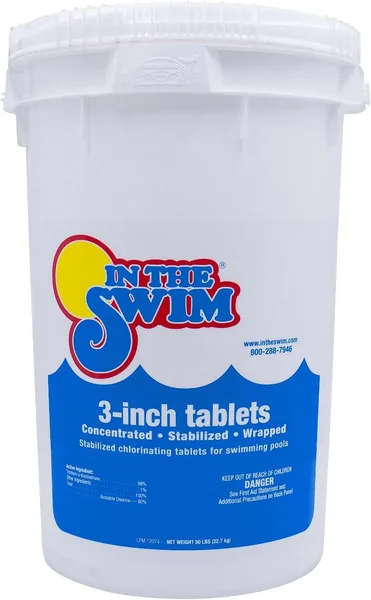
3" Stabilized Chlorine Tablets, 50 lb
5,000+ bought last month
Publishes its strength — 99% trichlor, 90% available chlorine — which is rarer than it should be and is what makes the calculator above meaningful. Buy this size only if you will use it; tablets degrade in a part-opened bucket between seasons.
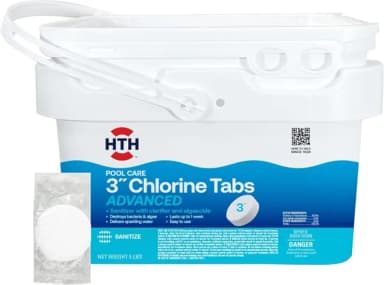
Pool Care 3" Chlorine Tabs Advanced, 5 lb
8,000+ bought last month
A 5 lb bucket for a small pool or a first season, where a 50 lb pail would sit half used until it clumps. Strength is not published on this listing, so treat it as standard trichlor.
Where this leaves you
The tablet count only works if the CYA number is real
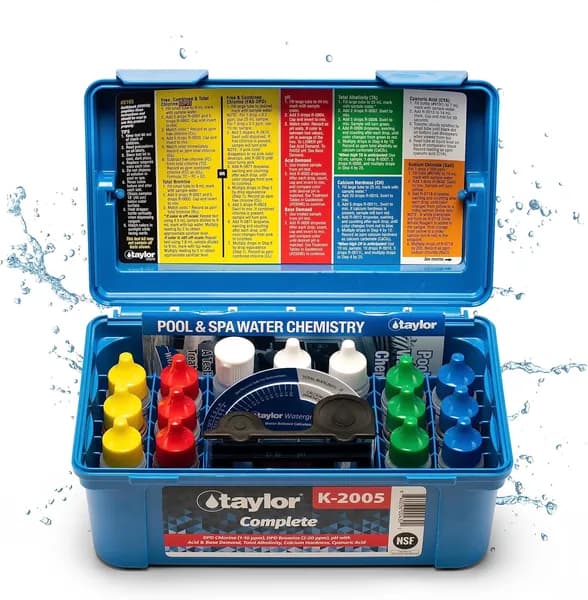
- Reads cyanuric acid by drop test, so you can see the climb before August does
- Buyers cross-checking strips found them reporting CYA 0 against an actual 40–50
- Monthly testing turns a forced drain into a planned one
- Reagents sold individually — the DPD bottle is the one that runs out first
We don't field-test products. This is the cheapest kit we track that reads CYA by drops.
What the threads keep arguing about