Chemistry · Updated 18 August 2026
Liquid, tablets or granular?
They all deliver the same chlorine. What separates them is what each one leaves in your water permanently — and that is the part the labels don’t mention.
How much chlorine, and what does it leave behind?
Every form adds something permanent. That's the real choice.
To raise free chlorine by 3 ppm in 19,200 gallons, add 59 fl oz of liquid chlorine (12.5%).
The short version
Chlorine is chlorine. The by-product is the decision.
Once it dissolves, every form on this page produces the same sanitiser — hypochlorous acid. There is no such thing as one form killing algae “better” than another at the same free-chlorine level. Anyone selling you that is selling you a delivery mechanism and calling it a chemistry.
What genuinely differs is the passenger. Trichlor and dichlor carry cyanuric acid. Cal-hypo carries calcium. Liquid carries essentially nothing. Both CYA and calcium accumulate permanently and leave only when water leaves, so the form you use every week is a slow decision about which number you will eventually have to drain away.
That reframes the cost question. Tablets look cheapest per pound of chlorine, and they are — right up until the partial drain they eventually force, which costs more than a season of liquid.
Two places to go from here: how many tablets your pool actually needs if you’re staying on tabs, or how to bring CYA back down if they’ve already caught up with you.
The four forms
What each one is actually for
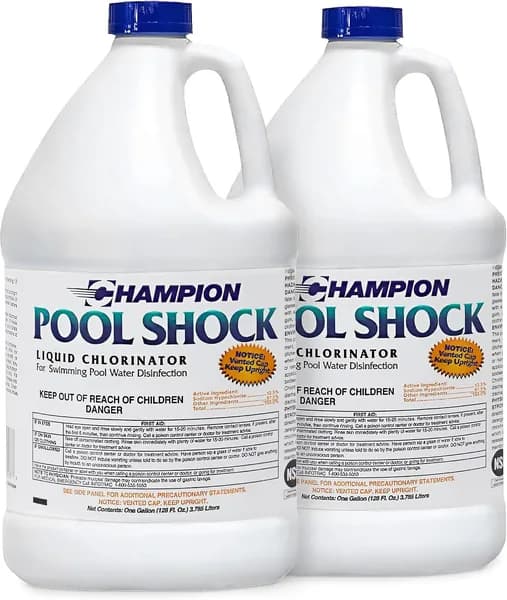
Liquid chlorine — 12.5% sodium hypochlorite
The default for anyone who has had a CYA problem. Adds nothing that accumulates: no stabiliser, no calcium, just a trace of salt. The trade-offs are real but manageable — it is heavy, it degrades in storage over weeks rather than seasons, and it will bleach anything it splashes on.
Best for: Corrections, hot weeks, algae recovery, and any pool whose CYA is already high.
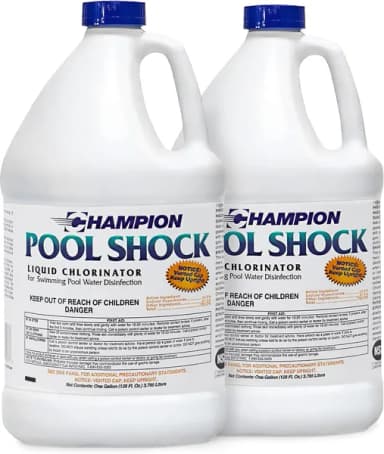
Liquid Chlorine 12.5%, 1 Gal 2-Pack
1,000+ bought last month
Trichlor tablets — 90% available chlorine
The most convenient form by a distance, and the reason most American pools drift into trouble. Each tablet stabilises as it sanitises, which is genuinely useful until it isn't. Best used as a baseline you top up with something unstabilised.
Best for: Holding a pool steady while you're away. Not a whole-season strategy on its own.
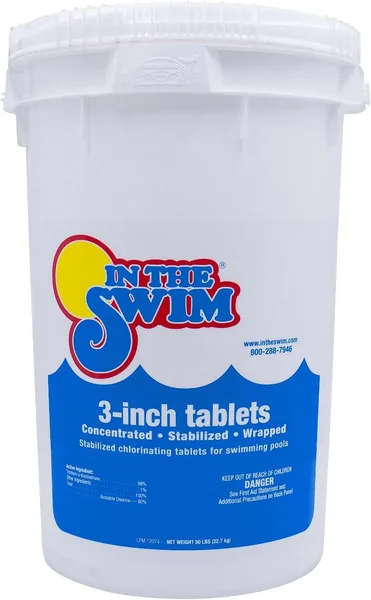
3" Stabilized Chlorine Tablets, 50 lb
5,000+ bought last month
Cal-hypo granular — 65% available chlorine
Unstabilised, fast-acting and cheap per pound, which makes it the usual choice for shocking. The catch is calcium: it adds roughly 0.7 ppm of hardness for every 1 ppm of chlorine, and hardness does not leave the pool either.
Best for: Shocking and algae clearing in soft water. Avoid where calcium hardness is already high.
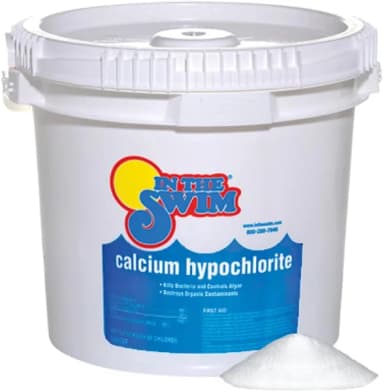
Dichlor granular — 56% available chlorine
The one we would steer most people away from for routine use. It is sold as shock, which invites heavy dosing, and it adds more cyanuric acid per ppm of chlorine than tablets do — 0.9 against 0.6. A hard week of dichlor can move CYA further than a month of tabs.
Best for: Spas and small vinyl pools starting from zero CYA. Rarely the right routine choice.
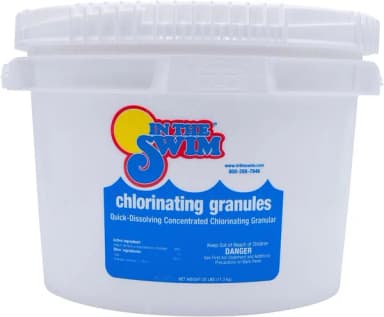
Sodium Dichlor Granules, 25 lb
700+ bought last month
The comparison nobody publishes
What a part per million actually costs
Computed from the listed price and the published available-chlorine strength of each product on this page — how much you pay to raise 10,000 gallons by 1 ppm.
| Form | Pack price | ppm per 10k gal | Cost per ppm | Also adds |
|---|---|---|---|---|
| Trichlor tablets, 50 lb | $154.99 | 539 | $0.29 | 0.6 ppm CYA per ppm |
| Cal-hypo, 25 lb | $109.99 | 195 | $0.56 | 0.7 ppm calcium per ppm |
| Dichlor, 25 lb | $139.99 | 168 | $0.83 | 0.9 ppm CYA per ppm |
| Liquid 12.5%, 2 gal | $36.99 | 25 | $1.48 | nothing that accumulates |
Tablets are five times cheaper per ppm than liquid chlorine. Not slightly cheaper — five times. We are not going to bury that, because it is the honest reason tablets dominate American pools and any article that skips it is arguing in bad faith.
What it means is that the case against tablets was never a cost case. Run a 20,000 gallon pool at typical summer demand for a 20-week season and you need roughly 350 ppm of chlorine over the whole season: about $102 in tablets against $518 in liquid. Even adding a partial drain to deal with the CYA those tablets leave behind, tablets come out ahead on the invoice.
The cost is risk, not money. Those same 350 ppm delivered by tablets add around 210 ppm of cyanuric acid, which pushes a pool deep into the range where chlorine is suppressed and one missed week becomes a green pool. Clearing that costs 6.4 gallons of liquid chlorine per dose, held for days — and that is the bill that actually hurts.
Which is why the sensible answer is neither/both: tablets for the baseline when you are away, liquid for corrections and hot weeks, and a CYA test once a month so you find out in June rather than August.
Worked example
One season, three strategies
A 20,000 gallon pool at typical summer demand — 2.5 ppm of chlorine lost per day across a 20-week season, or about 350 ppm total. Starting CYA 40.
- 1Tablets only — chemical costCheapest on the invoice by a wide margin$102
- 2Tablets only — CYA at season endFrom 40, plus about 210 added250 ppm
- 3Liquid only — chemical cost$518
- 4Liquid only — CYA at season endUnchanged. Liquid adds none40 ppm
- 5Half and half — chemical cost$310
- 6Half and half — CYA at season end145 ppm
No strategy here is free. Tablets cost you a partial drain and a season spent close to the edge. Liquid costs four hundred dollars more and a lot of jug-carrying. The split costs both, in half measures.
What most people who stay out of trouble actually do is closer to 80/20 than 50/50 — tablets as the baseline because they self-meter and work while you are away, liquid for the hot weeks and the corrections, and a monthly CYA test so the drain is planned rather than forced. The figures above are the boundaries of the trade, not a menu.
Storage
Each form fails in storage differently
Liquid chlorine degrades, and quickly. Sodium hypochlorite breaks down on its own, faster when warm and faster in light, so a jug that has sat in a hot garage for a month is meaningfully weaker than the label claims. This is the single best argument for buying it in smaller quantities more often, and it is why a dose that worked in June can appear to stop working in August with nothing else changed. Store cool, dark, and buy fresh.
Tablets clump. Trichlor keeps almost indefinitely if it stays dry, but a part-used bucket that has taken on humidity over a winter will fuse into a block, and buyers report exactly that. Individually wrapped tablets exist precisely to solve this — the wrapping does nothing for dissolution speed in the water, but it protects a half-empty bucket between seasons. That is the real reason to pay for it.
Cal-hypo and dichlor cake and are the most hazardous to store badly. Both are strong oxidisers. Keep them dry, sealed, off the floor and — this is the part that matters — never stored next to trichlor, acid, or anything organic. Cal-hypo contaminated with trichlor is a genuine fire risk, not a theoretical one, and the usual cause is two open buckets on the same shelf in a hot shed.
A practical rule that covers all four: one product per container, original packaging, lids on, and a shelf that stays under about 90 °F. Most pool-chemical incidents are storage incidents, not dosing ones.
Choosing between cal-hypo and everything else is partly a calcium question, so check where you stand first — the levels chart gives the target for your surface, which is not the same number for vinyl and plaster.
Where this leaves you
If you only change one thing, change what you correct with
- 12.5% sodium hypochlorite — the strength is published, so the dosing above is real
- Adds no cyanuric acid and no calcium: nothing you will ever have to drain out
- The form to reach for on hot weeks and after heavy use, alongside your tablets
- Buy smaller and more often — it loses strength in storage, faster when warm
Tablets are five times cheaper per ppm and we said so above. This is the one to keep alongside them, not instead of them.
Before you switch